Showing posts with label TV. Show all posts

The Good Wife: Everything is Ending

3 Comments »

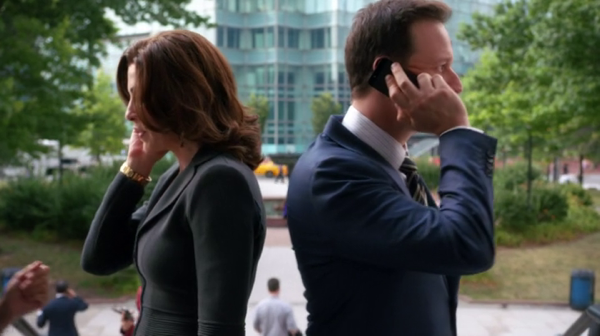
Vlcsnap 2013 09 30 23h40m02s138

Four years ago, after a spate of increasingly ridiculous sex scandals (vacation to Argentina, anyone?), CBS asked us to consider the woman standing on the side of the stage. They sold us a bleak scenario; home in tatters, a woman past her prime is forced to start over, not only to take care of the family, but to find her misplaced self.

That woman evaporated years ago, leaving us one of the most dynamic characters this side of Walter White. From beginnings so humble, Alicia Florrick is now the most powerful actor in this fictional world; she holds the fates of the Illinois Governor, Lockhart/Gardner, and a crew of young upstarts in her manicured hands. And she knows it.

It's remarkable that she's managed this ascent without ever playing the trickster; that she's playing that role now sets us up for high comedy and (one hopes) a new ruthlessness. The first casualty appears to be any last embers of the once great friendship between Kalinda and Alicia. (I always held that friendship up as one of the things that made the show unique, but in many ways, the show's refusal to easily rekindle that friendship makes it even more so. It's how these things work in real life.)

Vlcsnap 2013 09 30 23h33m50s10

But who will she become? By running off with Cary, she implicitly rejects Will+Diane's moral indifference. I can't be the only one who cheered when, after a momentary hesitation, Cary's simple statement that "we are the new Will+Diane" causes her to double down. (Related but not: "What's going on? West Side Story?" may be one of the greatest line deliveries in a show tripping over itself with great line deliveries).

Wild card: Alicia+Cary vs. Will+Diane may spar in the main theater, but I wouldn't bet against the impact of the looming proxy war: David Lee vs. Kalinda.

Vlcsnap 2013 09 30 23h36m50s19

GOOD FLORRICK, BAD FLORRICK

Alicia may have changed, but her central relationship hasn't changed much since my salad days of weekly reviews:

Whenever Alicia and Peter stand in the same room, there's a massive inflow of oxygen, ready to stoke the fires of everything that lies simmering under the surface. So much hatred, and also so much love, a love that pollutes and infects and prevents them from ever having a meaningful conversation about anything.

That strange rush of air still exists, but now that they're "together" again, it stokes a dangerous symbiosis.

Peter makes what will surely turn out a terrible decision. The first time I watched, I saw it as a failure to challenge his own failings by taking the easy (and likely fateful) way out by "promoting" Melissa George. The second time, I noticed that his decision immediately followed his musing that Alicia's leaving Lockhart/Gardner to get away from Will. He's saying, quite simply, "If she can be good, I can be good." Which makes me wonder if, until he had that assurance about her, he was planning on being less than good.

OTHER

1. The show runners have decided that esoteric baroque strings are part of the show's new DNA, and I'm ok with that. It just makes me doubly excited about the return of our favorite dead client.

2. If we see Cary and Alicia slamming tequila shots in every episode henceforth, I might (MIGHT!) almost (ALMOST!) get over the loss of my darling Kalinda/Alicia superhero friendship.

3. Love that Robin literally put a bird on it:
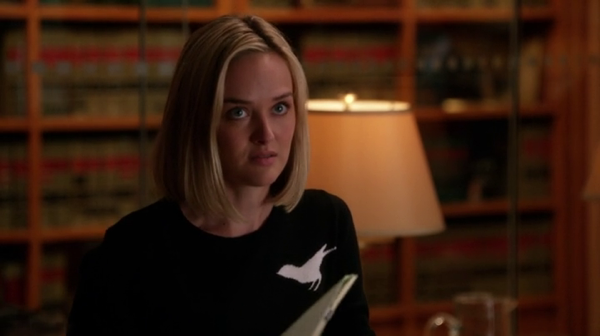
Vlcsnap 2013 09 30 23h35m58s1

4. These death row cases BREAK MY HEART. STOP IT, SHOW.

5. Um, I love Melissa George and can't wait to see where this story goes. Taste the pretty:

Vlcsnap 2013 09 30 23h40m54s151

6. Today in Kalinda Accent-Watch: "Well, aye caunt leagly access their cawls."

7. This is the only premiere that lacks a gratuitous sex scene. Did the censors finally catch on, y'all?

8. "You're right, but that doesn't mean it's his." "You're right. But it does mean there's no convincing you." Why isn't Geneva Pine a series regular? Come on now.

9. "Please don't end up hating me." AAAAAAAAGH DESK ATTACK OF UNPRECEDENTED STRESSFULNESS.

10. I actually don't even know what to say about Monica the telecommuter, because I'm too busy laughing hysterically at how Alicia's throwback do-gooderness last season has blown up in her face.

11. I enjoyed how the show's new fissures were brought to life in the filmography. There's not a single shot of Alicia and Diane together where they're not crowding each other off the screen:

Vlcsnap 2013 09 30 23h34m08s183

12. Not to mention Alicia and Will:

Vlcsnap 2013 09 30 23h38m49s176

Next week: DESK ATTACK OF UNPRECEDENTED STRESSFULNESS!!!

The Good Wife Season 4: "Waiting for the Knock," or, Eli Gold Learns What Hubris Meant to the Greeks

1 Comment »

NewImage

The Good Wife's "Waiting for the Knock" felt like the middle section of a very long novel - the writing's sharp as ever, you're still having a great time engaging with it, but you can't help but feel like the writers are taking a little bit of a breather before they get to the really juicy stuff.

That said, I'm more than intrigued by the new tone the show's adopting. The show's always been happiest in the moral grey area, but its ethos always centered on Newton's third law - every action leads to an equal or opposite reaction - which, in The Good Wife, means that even the direst consequences stem from an action taken, even if those actions are long-forgotten.

But then, most of the driving factors from the episode centered from something that didn't happen, a void of an intern who seems to have a black hole in her head. That Peter didn't actually sleep with her turns the narrative into a Greek tragedy - Maddy found the excuse she needed to turn on Peter (indeed, it seems like she was looking for that excuse from the start), and the blogger hurls away from the void in his own rocketship, powered by grist from the rumor-mill.

But we're not Greeks, and we know that the gods don't actually punish us for our hubris, and yet, it's the only explanation. Without Eli's arrogant response to the journalist, without his quickness at employing the heavy hand of Lockhart Gardner, without his incorrect belief that lying to Maddy would be the right way to keep her on board, none of these need have happened.

It's strange for a mainstream CBS show to use such subtleties to drive its narrative, but of course we know that our show possesses those characteristics in name only - it really is a most uncommon show.

TRAGIC IRONY THY NAME IS GOOD WIFE!

OTHER

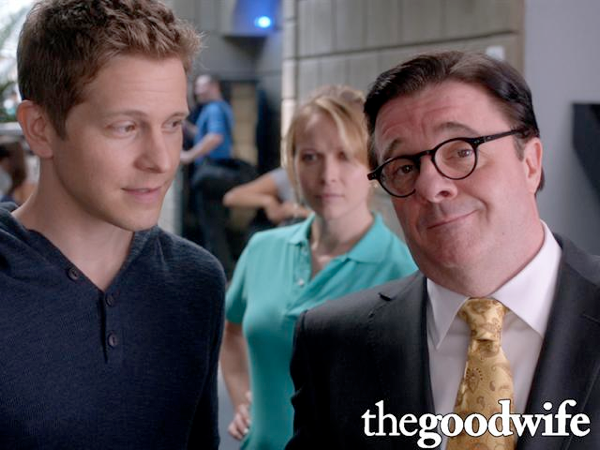
-Welcome back, Cary! I've missed your pretty face so! And kudos to the Kings for manufacturing hilarious homoeroticism between you and NATHAN LANE of all people. And thusly a thousand fanfics were born...(gif credit to fyeahcaryagos.tumblr.com)

Tumblr mcux04utIp1rpap4io1 500

-Diane would totally get into a dick-measuring contest with an opposing lawyer of any gender. Just one of the trillion reasons that we love her so.

-Kalinda, oh Kalinda. Stop involving thyself with douchebags, whether female FBI agents or British faux-thugs.

Finally, just posting photos of Cary Agos because hello! He finally had a role! And more because the gym trainer is clearly jealous of the love he shares with Nathan Lane.

NewImage

The Good Wife Season 2: "Two Girls, One Code"

3 Comments »

NewImage

It's a long time since Alicia ran out of the office with an expression screaming "DANGER WILL ROBINSON! NAUSEA! NAUSEA!". I admit, I kinda miss it. Julianna Margulies is at her best when Alicia's falling apart.

Last night, we saw Alicia drift on, borne ceaselessly into the past. Barely even touched by friction, she raced to a moment that's been building up for the past ten episodes or so: a temporary (and totally inevitable) reunion with Peter.

A variety of external forces attempted to fight against this - an intrepid reporter, an overzealous (and touched in the head) intern, and Alicia's own shenanigans. But none could stand in the way of the boulder rolling down the hill. You can fight gravity, but you'll always lose.

I'm not sure that Peter will be Alicia's last stop, but I'm happy for the show to explore this for a time. After all, when Alicia blips that she no longer cares what Peter does, Margulies' performance seems all too convincing. When she kisses Peter, one can easily believe it's driven by basic relief that she won't face a second round of public embarrassment.

The Case of the Week

You know those moments where you literally watch someone shrink before your eyes? A veil of worship lifts and the person you're looking out becomes small, perhaps even grotesque.

Well, this week's case was all about people trying to eye-shrink each other. Watching Will duke it out with gross Gross couldn't possibly have been more satisfying. The judge tore Viola and Ross to shreds, Ross tried (and failed) to tear Will to shreds, and somehow, even though the firm technically lost, we're left certain that they won. It's because Gross's "win" is so petty and, well, gross. Talk about a sore loser.

So of course our heroes laugh it off, and even Nathan Lane is forced to smile.

Kalinda and Horror-show: Let's just say, I have high hopes for Lemond Bishop's murderous instincts.

Play along in the comments! Thoughts on the ep?

The Good Wife: Season 4 Premiere

2 Comments »

Unlike previous seasons of The Good Wife, we're not starting the new season with a large unanswered question. This time, we start with a bunch of smaller questions, and by the end, we have a few more.

As a result, the premiere feels slightly directionless, even as it hints at the major themes of the year (more on these shortly). I assume part of the reason for the lack of cohesiveness is Alicia's physical separation from the Lockhart Gardner troubles. Dealing with Zach's sass-induced arrest has no relation to the financial issues at LG.

In many ways, she's also emotionally separate: she's in a good place in her life, she doesn't need to have everything in her life neatly defined (this is HUGE character growth for her), and the events of the past three years have left her with numerous fallback options, professionally speaking.

All of a sudden, she's moving very easily from politics to parenting to lawyering. One can only assume this cometh before a fall, as the most common trait of the jacks (and jills) of all trades is taking shortcuts. We see her do this in every way possible: she leans on Cary to use his connections, she leans on Peter to use his connections, and at the end of the episode, she makes the false assumption that she can have all of that and still be everything to Will.

I'd like to think that her newfound confidence comes from having her trusty sidekick/best friend by her side.

But now sidekick's got her own story! And I'm not sure I like it. Part of it's my rampant hatred of Marc Warren, who bears the honor of starring in the worst episode of Doctor Who ever, new or old. Also he's just LAME, with his midnight sun tattoo and his muscle shirts and his silver chain. I trust the Kings to show why he's any kind of match for Kalinda, but its going to take some effort.

That said, I'm mostly excited for the New Normal. It seems like The Good Wife's a rehab clinic for actors who've long ago been typecast as hopelessly broad (Alan Cumming, hello), and I'm as shocked/pleased as anyone at Nathan Lane's restrained performance. And I hope Kristen Chenoweth returns to spoil Alicia's comfortable uncertainty about the state of her marriage and to spoil Eli Gold's piece of mind.

So where are we going this season? Here are my guesses at the major questions for the season:

  • How will Alicia be affected by no longer being the most important character in Kalinda's narrative?
  • Is Zach more of an Alicia or a Peter?
  • What is the state of the Florrick marriage? Does it even matter? Should we just be rooting for Alicia to make it on her own after all
  • What strange costume will David Lee wear to the office this year?
  • How will Grace top herself in the department of incredible yet entertaining lack of logic?
  • WILL CHRIS NOTH BE ON THE SHOW FULL TIME???
  • Will Chandler Bing's show please be cancelled so he can smarm his way through Chicago politics full-time?

And MOST IMPORTANTLY, will any scene this season top the pure ridiculous hilarity of this scene?:

Why You Need to Watch Scandal

No Comments »

NewImage

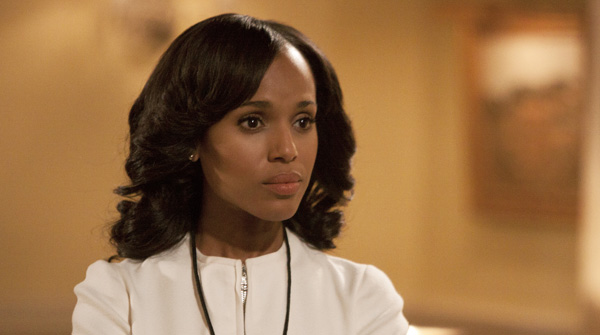
Unlike with many shows, I can actually name the moment I fell in love with Scandal. It's the most comfortably feminist show on television this side of The Good Wife, and one of the tightest, plottiest thrillers in recent memory. But that's not why I fell in love.

Scandal already earned a certain amount of goodwill from me for its African-American female showrunner and African-American female lead (seriously, when's the last time those conditions happened on their own, let alone in tandem).

But goodwill rarely translates to love. Goodwill's the annoying kid sister of love, or that boy who's so nice to you that you really want to like him, who treats you so superficially well that you stay faithful to him for months on end despite flavorless sex and a deep-seated yet ever-increasing disdain for his total obliviousness to how you really feel about him.

Luckily the show quickly surpassed my highest expectations. Scandal has a secret weapon, a character who reminds us in every appearance that this show is something else: Mellie, the President's not-really-suffering wife.

The first episode suitably introduces the show and the characters, but fail to tell us that the show will be anything more than a higher-stakes political simulacrum of Grey's Anatomy. We learn that our protagonist's one true love is the man she can never have (and by this point, really doesn't want to have). It's funny, it's witty, it's thrilling, etc.

Episode Two turns the show into a thriller (and what a magnificent ride it continues to be). Hints of conspiracy abound, and the audience soon realizes that the emotional stakes of our characters stand small against the stakes of the political mystery (and boy does that mystery build. Rhimes works in one of the most horrifying torture scenes I've ever seen. Like most horrors, what goes unseen is far more disturbing than what's seen).

In episode three, Shonda Rhimes mixes in the special sauce. We learn a little more about Olivia Pope (Kerry Washington, whose career's about to explode between this and Django Unchained) and her past relationship with the President. Crucially, a throwaway line, one that whizzes by so quickly that you could easily miss it, reveals that Mellie not only knows about the love affair, but recognizes the role that relationship played in getting her husband elected to the highest office in the land.

NewImage

There's a love triangle alright, but the President doesn't even figure into it: the unifying arc of the show's about Olivia, Mellie, and the Presidency, and the compromises and realignments they make to make sure that the highest office in the land stays intact, and dare I say it, respectable.

This setup allows Shonda Rhimes to wipe her ass with the Bechdel test over and over again. There's a wife and an ex-lover and they don't even talk about relationships. They talk about their roles in the world as they envision it; protecting Fitz, and by extension, their life's work. Their mutual respect and professional need for cooperation, supersede anything so quotidian as stereotypical female jealousy.

Because these woman are comfortable with who they are and what they want, they also have genuine friendships with the opposite sex. Genuinely platonic relationships, without telegraphed sexual tension, still feel sadly revolutionary in contemporary television.

The best thing of all about the show? It's thematic affirmation that in the real world, there are no white hats. No one really lives on the poles of good and evil. I haven't really talked about the other characters of the show, or the ongoing mystery, but I don't want to spoil you (it's twistier than Revenge).

I'm going to start regularly writing about the show, and I hope more of you give it a chance. The first season is streaming on Netflix, and I recommend it for a rainy day.

Doctor Who and the Asylum of the Daleks

3 Comments »

NewImage

Welcome back! Apologies for lateness, but I just got back from India after a wedding and a funeral, and attached emotions thereof. But onward and geronimo! As always, don't read if you haven't seen it.

Once you get past the supremely irritating Omg!RelationshipTroubles!, Asylum of the Daleks proves to be the strongest outing of the series since the midseason finale last season (the plastic clones, if you recall).

The writers have finally embraced (or at least recognized) the fact that through repetition, they've neutralized any sense of terror that the Daleks once elicited. Really, once an apron-clad Dalek offers you tea, there's no going back. Now they're the "most terrifying creatures in the universe, except when they're working as housemaids, emoting on Broadway (truly, a Dalek attempting an American accent must be the most terrifying thing a viewer can see), and blathering on about Eggs--Eggs--Eggs."

NewImage

For the Daleks to continue to be villains that are even interesting, let alone scary, the writers really need to play around with the concept. Whether they're successful or not's a different matter, but at least they're trying.

The very concept of an asylum for the Daleks never really lived up to its potential (or any real definition, for that matter). It provided a suitably creepy framework for the ultimate Human Dalek (Oswyn-lek), but the setting wasn't developed properly (I assume this is a matter of time. This story could easily have been a two-parter). After all this, I have no idea what it actually means to be an insane Dalek. You turn them on, they start shooting. Same old Eggs-terminators.

But who could help but smile at the references to Classic Who adventures with the Daleks? The City of Exxilons is a particular favorite of mine. Basically, it's the Daleks vs. the insanely creepy Exxilons versus a massive puzzle labyrinth. Also, Sarah has a mullet:

NewImage

NewImage


Business in the front, party in the back. But I digress.

Asylum of the Daleks also provided us with a surprise appearance by Jenna-Louise Coleman, recently announced to be the new companion. While I emitted a heartfelt MEH at the casting of another teenage white girl character, she totally won me over in this episode. That said, she's dead. Who knows what the real companion will be like?

And speaking of dead, why didn't the Doctor try to save Oswyn-lek? Again and again, she proves that she can exert her will over the Dalekness that attempts to control her, even at the end. These aren't the angst-filled self-recriminations of the lone ranger in Dalek, Oswyn-lek is completely, genuinely human, with all the hopes, dreams, laughter and failure of any other non-Dalek being.

I love these little moments that reveal that even the Doctor, with all his worldliness (universliness?) has moments of prejudice that he simply can't put aside. It's these little nuggets that make him seem more human, and the more complicated hero that Moffat has sort of hinted at throughout his era, but has told us about rather than shown.

Tell me, what did you think about the episode? Play along in the comments!

A Loving Note to Twin Peaks, Season One

6 Comments »

NewImage

When Laura Palmer dies, David Lynch would have us believe that even the Gods have nothing more important to do than mourn her presence. Every living body in this town, faced with the evacuation of life from Laura's strangely serene face, falls to pieces. So far, so Killing.

NewImage

Agent Dale Cooper breezes in, a cherry-pie scented breath of fresh air, just when the weeping becomes too much to bear. Sherilyn Fenn's Audrey Horne has the good sense to laugh in the face of the rapturous weeping in the high school classroom. The audience breathes a massive sigh of relief, as we realize that Lynch/Frost intends more for our digestive-hour than the maudlin.

As we settle into the (admittedly strange) rhythms of the show, I genuinely can’t figure out whether David Lynch loves or hates teenage romance. All the characters are whimsically and lovingly drawn apart from Donna and James, who drip water bodies of sentiment wherever they go.

NewImage

Even Bobby Briggs, douche-jock extraordinaire, seems to have more depth to him than our drippy lovebirds. He moves easily from scene to scene, and we're never quite sure if he's operating from the high-emotional state of an adolescent teenager or from something more clinical, more mercenary. Lynch knows this; even at Bobby's most tender moments, you can always hear the frictional creaks of his faux-leather jacket.

His relationship with Shelley remains compelling even when their existential threats become more and more ridiculous, as Leo can never quite sell the idea that he's some kind of unrepentant misogynistic abuser. The more Eric DaRe tries, the more I want to laugh at his pug-nosed face and its terrible attempts at acting.

But with Twin Peaks, Lynch/Frost have achieved the impossible -- a show where bad acting actually heightens its sense of atmosphere. The gurning, the posing, even the sheer emoting, never quite seem out of place. Sure, there's a murder mystery, but who the hell cares? We want to see Dale Cooper, eccentricating himself up all over the place. We want to see Audrey Horne, Veronica Mars-ing her way through leches and peons alike.

NewImage

In a show full of one-armed men and dreamed up gophers, one mystery really drives the story forward. Is Audrey Horne quite real? She's everywhere and nowhere, all at once. She's all-seeing, all-knowing, impossibly beautiful, and yet she seems connected to nothing and no one apart from Agent Cooper.

I could never call him Dale. Could you?

Goodbye, Mary Tamm, the Noblest Romana of them All

No Comments »

MaryTamm

2012, it seems, has a vendetta out for the actresses who played the most beloved Doctor Who companions of yesteryear. In the space of one year, fans have waved goodbye to Elizabeth Sladen, Caroline John, and now, heartbreakingly, Mary Tamm.

Oh, Romana. The only time the Doctor took one of his own kind on board, and she not only equalled him, but eventually defeated him in the saving-the-universe stakes. Mary Tamm brought us the first regeneration of Romana, fully regal and bitingly sarcastic, a Timelady arriving on the TARDIS by way of Downton Abbey.

Her first scene on the show remains one of the most perfect in the show's history, displaying the wit, the vibrance and excitement of finally having a companion who doesn't worship the Doctor, but actually kind of thinks he's a loser at first. At the end of the day, has anyone else called him on the fact that he's basically a dropout vagabond thief?

Mary Tamm left the show because the character changed; she became more of a typical "excellent question, doctor" companion by the time she left. But strangely enough, Lalla Ward chose to reference Tamm's performance in Romana II, and the writers returned Romana to what she was always meant to be; better than the Doctor. We owe Mary Tamm for providing a template that no companion has matched since. And it's worth noting that the Romana years (both Romanas) garnered the highest ratings in the show's history.

(skip to 5:18 for Romana's first appearance, where even K9 can't resist a lengthy ogle. Is there such a thing as the tyranny of the robot gaze?)

Political Animals vs. The Good Wife

No Comments »

NewImage

Two episodes of Political Animals have left me with less of an opinion on the show itself, which is a sort of feel-good trashy romp with a facade of political relevance, but with more appreciation for the narrative construction of The Good Wife.

Superficial comparisons abound. While Political Animals explicitly bases its lead on Hillary Clinton, The Good Wife uses the story of the jilted political wife to deliver a deep dive into how politics, relationships, professionalism tie in with the consistently difficult task of being a woman.

So while the story has to go through some of the same beats (the iconic image of the wife standing by the husband on the podium as he admits his faults, the horror of discovery, the complexity behind the decision to stay or leave), it's telling which beats each story omits.

NewImage

The Good Wife doesn't spend a lot of time on the tears; when we meet Alicia Florrick, she's competent, she's independent, and she's completely certain of what she needs in her professional life. The Good Wife focuses on how she moves forward, not what brought her to this point. We're shown exactly why Alicia doesn't leave Peter as yet, and we realize that in the end, dealing with Peter's the lowest priority in Alicia's life, given that her whole world has come down around her. In fact, it isn't until season three that we get the scene where Alicia first learns about Peter's indiscretions.

Political Animals, on the other hand, seems totally mired in the relationship between Bud and Elaine. One major problem with the show so far is how Bud seems to have such a hold on Elaine's life, even though there's no evident reason why she would ever have loved him, why she would have stayed with him, and why she relies on him now. We're shown, again and again, that she doesn't really need him in her personal life, so allowing him back in doesn't seem true to the character.

I'll allow that few shows get off to such a strong start as The Good Wife. It almost seems churlish to compare the two: TGW is a novelistic tale that teases out very serious themes, while Political Animals aims to be trashy entertainment (and succeeds admirably). Nor should they be more similar; Alicia and Elaine, despite the surface similarities, are very different women. If anything, Elaine's more of an example of when the world crashes down on a Diane Lockhart.

All that said, Political Animals does manage to mimic my personal favorite aspect of TGW: the Alicia/Kalinda. As with that favored pair, PA features a wonderfully prickly but respectful relationship between Elaine and Carla Gugino's fabulous reporter. It seems that in this show, too, the tensions between their deeper solidarity will drive the show forward. And I can't wait to see where it goes.

NewImage

On Loving Unlikeable Characters in Fiction

4 Comments »

NewImage

What do Girls, We Need to Talk About Kevin, Young Adult, and Confederacy of Dunces all have in common? These works, broadly considered to be the most polarizing (and challenging) of our time, all feature protagonists that most of us would happily lock inside a vehicle set on cruise control over the side of a very tall cliff. I, however, would at least wait until the story's over.

The unlikable protagonist sets up a delicious tension in any work of art; we don't like them, so we automatically dismiss everything they hold to be true, until slowly, almost imperceptibly, we start to recognize a little bit of ourselves in them. Once that happens, we can't help but hate ourselves, just a little: "If I see this much of myself in that character, how much more might be there that I'm not seeing?"

You see this most readily in critiques of Lena Dunham's fabulously horrible Hannah Horvath, in Girls. "I would never behave this selfishly, therefore I find it impossible to believe that Hannah could act in such a myopic manner," reads so many comment threads.

However, even by making that comment, you show that something about Hannah's character mirrors your own, unsettling you in a way that makes you rush to dismiss that connection by stating that her character is "impossible in reality."

NewImage

The common trait of the unlikable protagonist is a gargantuan level of self-involvement. Who wants to admit such a quality to themselves? More to the point, who can even recognize that quality in themselves?

In Young Adult, Charlize Theron plays a character who's morally vacant and miles beyond redemption, though she's wonderfully inventive in ways to destroy her life and the lives of those around her. We applaud her creativity and complete lack of self-awareness, even as we pray for her come-uppance.

But something strange happens; we learn that her humanity is not destroyed, merely suppressed. It's been beaten down so far that it only surfaces for a second before receding back into her, where it will likely remain. And so we arrive at the painful truth: she's completely self-aware, but circumstances have taught her that this is how to live in the world.

The truth about the unlikable protagonist is that he or she holds a mirror to our unknown selves, and makes us take a closer look at our morality and our idea of humanity. Eva Katchatourian, in Lionel Shriver's We Need to Talk About Kevin, suffers horrible consequences because of her monstrous son's actions.

NewImage

She didn't commit the crime, but she receives ample punishment. But we don't like her, so we feel she deserves it. What does that say about us, that we accept that the act of selfishness is as deserving of punishment as the brutal murder of scores of schoolchildren?

This is why I love the unlikable protagonist, and why that same character can be so off-putting to others. They take us to the dark places within our souls, forcing us to confront them instead of shrugging them off or cloaking them under a thin veneer of "morality" or "redemption." It takes all types to make the world go around, and I believe these stories arm us with a smidgen of empathy. And usually they provide us with a hell of a lot of laughs.

Who's your favorite unlikable character? Or do you find this type of fiction unreadable/unwatchable?

The Good Wife: "Pants On Fire"

No Comments »

NewImage

At last, Jackie's malevolence comes front and center. As much as I've focused on Alicia and Diane as the opposite poles of feminine choice, I've ignored what came before: those who find total validation through manipulating the men in their lives.

She's a character as old as time: Jackie's the end product of Great Expectations and the Manchurian Candidate. She's every wicked fairytale stepmother, vengeful Greek goddess and Miss Havisham, all rolled into one. She's Betty Draper, with even more ambition.

But even when doing her worst, Jackie still has to pretend she's motivated by something greater than herself, that she's acting on behalf of her family. It's transparently false, but the fact that she has to make that lie says something about who she is.

She stands in direct contradiction to Kresteva, who doesn't even pretend to justify his subterfuge. He lies, and he loves it.

NewImage

Even Peter, the closest we've had to a real villain on this show, lies to protect some image of himself as a family man and a just litigator. Kresteva's truly heartless, a cynical practitioner operating in service of chaos and entropy.

He isn't guided by the goodness of his heart or the assurances of his head or even the failings of his libido. He's a marvelous addition to the show, throwing everybody off of their games. In some ways, he's Kalinda, if she actually achieved the lonely heartlessness she (and Will) claims to desire.

But Kalinda's thirst for power finds direction through love, love of Alicia. Kresteva's lies inside of himself, taking over his entire being. He has to be defeated, because he's a black hole.

And that's why, despite a hundred objections, I'm firmly behind Alicia teaming with Peter to defeat Kresteva. It's gratifying that all the turmoil of the season has finally found a focus: preventing total entropy. Whether it's Jackie or Kresteva, the sociopaths must be stopped. And if they have to work together to defeat them, so be it.

OTHER STUFF

Kalinda and Alicia are friends again! I'll stop mentioning it when it stops making me grin from ear to ear.

Angry Peter is the sexiest Peter. It isn't difficult to see why Alicia was blinded by him for so many years.

Meanwhile, Will's become the legal equivalent of the star athlete struck down by mono, totally impotent, but still pretty convinced of his awesomeness (it's Will, so let's face it, he's justified).

Eli does something related to something tangentially related to the plot. That's all I'll say about that.

Also, there's a case. I think.

5 Reasons We're Glad Revenge is Back

4 Comments »

NewImage

Revenge isn't a show I regularly recap, because quite frankly, I wouldn't even know where to start (I will kindly refer you to Hello, tailor, who has written an unmissable post on the fabulous sartorial stylings of one eccentric billionaire, Nolan Ross: http://hellotailor.blogspot.com/2011/10/new-style-crush-nolan-ross-in.html).

But don't mistake my wordlessness for a lack of interest. Here are 5 reasons we should all be grateful for the return of Emily Thorne and her various doppelgangers.

1. Jawdroppers - I rely on Revenge to bring me the gasps that The Good Wife inspired in its second season. Anything goes, and that isn't just a marketing ploy. I still worry whether its relentless pace is sustainable, but to be honest, I've been worrying about that since episode three, and 15 episodes later, the writers haven't disappointed.

2a. Music Part 1 - The ridiculously over the top classical music (usually cello) that accompanies 90% of the DRRRRRRAMA. I feel like like this old promo says it all:

2b. Music Part 2 - The wonderful female covers of traditionally masculine songs that accompany the remaining 10% of the DRRRRRRAMA (let's face it, it's Revenge. There's nothing but drama). Yes, folks, that's a Metallica song below.

3. Nolan Ross - What on earth would we do without his bizarre non sequiturs? In a show that often plays like an even darker version of Veronica Mars, he's the one true friend, the one who gets himself mixed up in the darkness, knows it, and still comes back for more. And always with a sly wit.

NewImage

4. Madeleine Stowe and Emily van Camp - What would this female-driven show be without its leading ladies? Revenge takes a lot of stick for its overt genre trappings, but at the end of the day, these are two of the most complicated, well-developed female characters that have ever graced the tv screen. Neither of them fit neatly into the heroine/villain tropes, and we wouldn't have them any other way.

NewImage

5. Eye candy - No one on this show's gonna break any camera lenses, but there's an uncommonly attractive cast of characters. Emily van Camp's a heartbreaker, of course, but I personally cannot choose between her two loves (narratively speaking, though, Daniel has to die. Let's see if this bears out). I'll let my 14 year old self stare at Nick Wechsler until she works it out. Play along in the comments. Preferable with pictures.

NewImage:

Mad Men: Season 5 To Date, or, Mad Men: The Sitcom

2 Comments »

NewImage

I've meant to do comic recaps of the show like I did last season, but as I've pointed out elsewhere, it's hard to create comic recaps of a comedy. And even if Mad Men isn't striving to be a comedy, persay, it now lives in a vaudevillian space, with real human emotion transformed into grotesques and American history as paranoid horror.

The show hasn't lost its energy, but that energy has been rocketed in a million different directions, creating a season that might charitably be described as a mess. An entertaining mess, to be sure, but a mess nonetheless.

With a few exceptions, the characters have lost their humanity and have become enslaved to Matt Weiner's machinations, plucking at the bolts of their lives with as little agency as Ken Cosgrove's sad little robot.

It makes a certain amount of sense that Don's become static, and there's an inherent tragedy in what's happened to Roger, but Pete's so fickle that he hardly seems like a real person anymore.

Pete's desperation for Don's approval has become more than a little tired. It's difficult to sympathize with his struggle to establish his manhood, because his idea of what manhood ought to look like is so nonsensical in the first place. Trudy certainly hasn't emasculated him, and he has a powerful position at the firm.

He's the John Updike character in a show that always had more of a Richard Yates or John Cheever flavor, searching for petty pleasures rather than clawing at the world to find a path to humanity.

That said, how could I object to anything that leads to this?

NewImage

All punching aside, the strongest stories in this new Mad Men involve those characters who are still forging ahead to create their own destinies, fighting the tides: Megan, Joan and Lane.

And where our old guard remains interesting is how they respond to the new fire within these three characters. Take, Don for example.

He has officially become your curmudgeonly Grandpa, more content to sip scotch while sitting in his boxer shorts and watching a ball game than horror of horrors, socializing.

Don's  life has become epitomized by the incurious "why":

  • "Why do we have to go out on a Saturday night?"
  • "Why can't I just stay in with you?"
  • "Why have you dressed me in the sartorial equivalent of a hurdy-gurdy?":

NewImage

He allows himself to be railroaded to a certain extent, because it's what he wants at this stage in time. Like most men who've encountered their share of angst and self-destruction, what he longs for in the end is a measure of peace. That's why his own personal nightmare involves the most dramatic destruction of that peace possible, where his entire ability to make decisions for himself is challenge by animal fears.

For the terrors that the world brings cannot ever match the terror he feels in his heart, the fear that he can never settle down and stop destroying his own life. Dick Whitman's more terrifying to him than Charles Whitman could ever be.

So while I'm tiring of the repeated sensationalism of this season and the necessity to insert not just one but usually two contemporary set-pieces into the cozy SCDP world, I feel like those events are meant to reflect what's going on inside of Don. But the lens has grown too large.

Play along in the comments, and I'll be back next week!

The Good Wife In Review: "Gloves Come Off", or, Diane Lockhart Wins At Everything

3 Comments »

goodwife-2x17-alicia-kalinda.jpg

This episode featured the most important thing to happen in this year of The Good Wife: the restoration of my beloved Alicia/Kalinda. But not without a red herring, of course. Kalinda poured her heart into that bottle of beer, and Alicia smashed it onto the floor, along with my heart and soul.

Alicia's searching for a home, but at last, she finds Kalinda instead. (Which may or may not have resulted in my jumping feverishly upon the couch like a small child).

THE BALLAD OF ALICIA AND DIANE

I can but hope this puts an end to a storyline I'd describe loosely as "Alicia's head is spinning out of control", and she's allowed to return to some level of confidence.

It's become apparent that many of the headwinds in Alicia's life have been caused by a lack of choice; she couldn't choose the direction of her marriage, she couldn't choose her friendships in a way that suited her, she couldn't choose to continue a torrid affair that brought her some amount of pleasure.

Having financial freedom will, at a base level, allow her some level of choice. The freedom to choose where you live is freedom indeed. And that freedom, that restoration of a certain amount of control, allows Alicia to make another choice (the best choice): letting Kalinda back into her life.

NewImage.png

Contrast with Diane, who's nothing but the amalgamation of choices well-made. Importantly, they're not the right choices for some false ideal of womanhood, but the right choices for her. When she pulls out her little black iPhone for a booty call, we cheer, for she deserves real lovin' from real men.

Even so, it's becoming so tense, watching these two very different women stand in the same room as each other, recognizing each other as both equals and opposites. When Diane tells Alicia off, you have to know that on some level she's proud of Alicia, that Alicia's finally gotten tough and taken control of her life.

And because Diane's not a hater, she recognizes Alicia as her equal, and gives her the damned raise. Well done, Alicia. Harvard Business Review would be proud (and so, I assume, is Canning).

OTHER THINGS

-As always, brief interactions between Cary and Alicia set the heart aflutter. A weirder, truer friendship has never been seen on television.

-Oh, Canning, and his fictional chauffeurs.

-I for one hope that Diane doesn't make a choice between Kurt and Jack. She deserves all the ruggedly hot men she can get her hands on.

-Tammy...still sucks. Though she seems to be the catalyst that brought Alicia back to Kalinda, so I can't hate her too much. Add to the fact that she uttered the following sentence aloud: "Will never not responds." So much grammatical hate. Also she says "It wasn't over between Will and I." So much more hate. Alicia, throw a book at that woman. Preferably a guide to grammatical English.

-Whoever staged the direction of this scene is my absolute hero:

NewImage

The Last Supper symbolism isn't lost on me. Does this mean that David Lee is Mary Magdalene?

The Good Wife in Review: "After the Fall," or "The Merry Wives of Gardner"

7 Comments »

NewImage

It's been a few weeks since I've jumped off the Good Wife blogging train, and I've missed you all dearly! Admittedly, it's harder to find the motivation to write during these "transitional" episodes, which seem more concerned with setting up future drama than with driving the story along in themselves.

I recently connected with another superfan, the wonderful writer of Lockhart Gardner. She matches my irrational love of all things Kalinda with an irrational love of all things Gardner, so we have a grand ol' time. Like Will's sisters, when Kalinda and Will are in scenes together, our heads explode (and probably the neighbors' as well, what with all the disconnected screeching. Anyway...).

Which allows me to neatly segue into the events of this episode, which might be neatly retitled The Merry Wives of Gardner. Not sure who's Falstaff in this situation, but I digress.

Once again, the episode was pretty Alicia-free, which makes me slightly concerned for the narrative of the show. Love or her hate her (and those who hate her, I know you're out there, but I really don't get it), the show's definitely about her. So while it's nice to see Will's domestic life for a change, it's a bit jarring, given that the plotline doesn't really tie back in to the story at large. And Will? Just go backpacking. No one said 6 months off means 6 months SITTING IN YOUR AWESOME-SAUCE APARTMENT.

Alicia spent most of her time this episode taking a backseat to Caitlin, which, first of all, EWWW CAITLIN, and second of all, really? Alicia's never been prone to professional jealousy (see: wonderful relationship with Cary in season 1), so it's weird that it's manifesting with Caitlin, especially given that she KNOWS Caitlin's gotten where she is with family connections. Not to say that Caitlin's incompetent, but David Lee transparently intervenes on her behalf. I look forward to finding out what Faustian bargain she's been forced to make with him in regards to the imminent political coup of extreme skullduggery and viewer joy.

This show's never more enjoyable than when it takes on office politics. It certainly helps that David Lee and Julius are such well-rounded characters, even though we can never tell exactly what they're planning next. In many ways, Eli's much more predictable in his behavior, so I'm not sure he's gonna land on top of this little play. We're starting to see a childish side to his character that I'm enjoying, as he scolds Peter and tries, yet again, to play silly power games with Diane.

I suppose what makes the whole thing so wonderful's that we know, deep in our hearts, that any number of David Lees, Julius's and Eli's still can't compete with one amazing Diane Lockhart. Though the writers will undoubtedly attempt to convince us (me) otherwise.

THE OFFICE OF THE STATE'S ATTORNEY

Oh Cary. There goes that moral higher ground, eh? I've been saddened by how ADA Pine's been repeatedly passed over, as she's clearly the most competent, driven person in the state's attorney's office. I smell a coup in the office, coming from her direction. She's not dumb enough to fall for Wendy's transparent manipulations, and she's dangerous. Cary's building a laundry list of enemies from women he used to fancy...apart from Kalinda, of course.

As for Peter? Was anyone even slightly surprised at his turn away from keeping his hands clean? Peter's fundamentally a party politician. When he behaves otherwise, it's because he knows that decision still serves himself. It's a slippery slope: I can only hope we get to bear witness to a whole shitload of Peter getting his hands dirty.

The Good Wife in Review: "Another Ham Sandwich"

8 Comments »

NewImage

Apologies for my absence, folks! Owing to some exciting life developments (The Oncoming Hope Forges An Atlantic Crossing!), I've neglected my Wife-ly duties (and missed the chance to comment on two corkers of an episodes). I hope to make it up to you with not Good Wife post this week, but two, or possibly even three!

For now, let's look at the lay of the land following the conclusion of this episode.

The problem is, dropping Will's indictment doesn't defray the other bomb that could have gone off, and may have put a couple more in motion. Dana still possesses Alicia's forged document, and recorded testimony ties Peter to these accusations of judicial misconduct.

So while it appears that Wendy's crawling out with her tail between her legs, it also seems a little like she's still set events in motion to achieve her central goal: the destruction of the Florrick family (not to mention Will, but reporting him to the bar seems more like an act of pettiness than anything else).

The other problem is, Our Heroes won the case by entirely discrediting our resident Dead Eyed Psycho. They didn't manage to prove Will's innocence, so an investigation by the bar might yet ruin him.

FLORRICK VS. FLORRICK

Whenever Alicia and Peter stand in the same room, there's a massive inflow of oxygen, ready to stoke the fires of everything that lies simmering under the surface. So much hatred, and also so much love, a love that pollutes and infects and prevents them from ever having a meaningful conversation about anything.

So when they finally face-off, when Peter shows his hand (even though Alicia doesn't), we experience the emotional equivalent of standing in the epicenter of a bomb blast. Their conversation may have revealed more about where the two of them stand emotionally than anything else in the show, ever. They both feel deeply wounded by each other, and they both keep pouring salt into those wounds, and take no pleasure in doing so, but just can't help themselves.

Every new denial of her relationship with Will hits Peter like a bullet. So if we can assume that Peter now knows the truth, how will their relationship change? I can't even pretend to anticipate, but I hope that the writers send someone to kidnap Chris Noth from Broadway and force him into a bigger role on the show.

OTHER STUFF

(also known as the section where I get to drop any pretense of analytical detachment)

2vlOt.gif

Kalinda: "My lips are sealed, but my eyes say I have a baseball bat with your name on it." Seriously guys, but I hope Dana gets her comeuppance in a big way. Then again, lack of foresight may be torment enough for someone in the legal profession.

Quote of the episode goes to Eli:

"You know the only problem with Sun Tzu: he never fought the Jews...we don't mess around with mind games, we useknives."

And guys? How hot is Alicia here:

X3k4q.gif

(gifs courtesy of kabletown.tumblr.com)

What did you guys think of the ep? Play along in the comments, yo.

The Evolution of Diane Lockhart

2 Comments »

NewImage

The New York Times livestreamed an absolutely fantastic roundtable conversation between the writers and stars of The Good Wife. The conversation touched not only on the show, but on the role of women in the media, on liberal tendencies to blind themselves to certain realities across the aisle, on censorship on network television, and most importantly, Josh Charles' erotic lunging.

I'm unable to embed the video, but you can (and should) watch it here: http://new.livestream.com/channels/387/videos/76513

What really surprised me was how little attention was paid to the romances and intricate plotting of the show, and how much was paid to the construction of particular characters. Unexpectedly, much of the conversation centered on Diane Lockhart, who has become one of the most revolutionary characters on television, but almost wasn't.

2aFmK.jpg

According to the rules of Desperate HousewivesGrey's Anatomy, and whatever excuses for television they air on Fox, a woman over 40 is characterized by loud desperation. They leap to men like moths to a flame, despite the fact that the biological tick-tock has long ago stopped (for the most part).

And yet, Diane gets a sexy dalliance of her own. It's not even remarkable that she's an outspoken feminist Democrat, and he's a gun-toting tea party member. It's remarkable how normal their relationship is. It's sexy, it's exciting, and it's constrained, the way all relationships suffer from circumstance (Alicia would agree, I'm sure).

This is because time hasn't fundamentally transformed Diane Lockhart. Most women aren't transformed purely by time, there are usually other factors in the mix (again, ask Alicia). Diane is happy with her lot in life, and when she lashes out, it's against existential threats, not against the ravages of time or against "men".

Speaking of existential threats...

9C4ZB.jpg

As Robert King points out, Diane was originally conceived as "the mentor who tries to sabotage the mentee," an idea that comes off as arch and a bit troubling in the the pilot. Luckily, the first episode is the last we see of that.

By the time real tension flares up between Diane and Alicia, Alicia and Will's liaisons are actually threatening Diane's entire livelihood, not some fictional idea of what it means to be a woman in a man's world.

One of the things I'm most looking forward to in the second half of the season is the development of the idea that Diane is an alternate universe version of Alicia. Until now, Diane has been a peripheral character in Alicia's world, and it makes sense that Alicia had to reach a certain point in her own journey for Diane to really enter her life in a more meaningful way than mentor-mentee or boss-subordinate.

Alicia almost had to put her private life to bed before she could enter the electron-proton dance with Diane. They're opposite sides of the same woman, and it's fascinating to watch these opposites fight against each other for primacy. I can't wait to see what happens, but if I continue this silly metaphor, I bet it'll be nuclear.

zhDZV.jpg

I think one of the best decisions the Kings made was to shift Diane from being an antagonist to Alicia to being a more general force of her own within the firm. She's never just protecting herself, she's protecting all those who work with her, even Will and Eli, who pretend they don't need a moral center.

She isn't bitter, she isn't regretful, this is her life, and she loves it. It's a character that stands apart from any other on television, where middle aged women are continually played as personifications of loss and/or longing (loss/longing of looks, loss/longing of years, loss/longing of choice, and so on).

Which is why the McVeigh storyline works so well: she experiences emotion as a normal human being, not as some cliché subset of gender and age.

She's an inspiration to all of us because, unlike so many other female characters on television, she's real. She gives us a roadmap for how to live our lives, how to balance our ideals with pragmatism. She doesn't live in a cloud, nor is she consumed by her own neuroses.

Diane Lockhart love letter...out.


(primary image credited to liveitout.tumblr.com)

Homeland and the Story of Cassandra

2 Comments »

7CRm2.jpg

For all the shocking twists and turns of Homeland's season finale, the most surprising realization came after it was over. Underneath the moral and political complications of terrorism policy, beneath the sensitive portrayals of the mentally damaged, lies a simple retelling of the story of Cassandra.

You remember Cassandra. She was given the gift of prophecy, but then she pissed off Apollo, who put a curse on her that no one would believe her predictions.

Carrie's mental illness becomes the modern simulacrum of Apollo's curse. Makes perfect sense, doesn't it? She's gifted with a brain that functions in marvelous ways, but her malfunctions deprive her of all credibility.

In this scenario, Brody clearly becomes Odysseus, who is often described as "Odysseus the cunning" or "cruel Odysseus," depending on whose side you're on. He returns to his long-suffering wife after journeying through torment, war, and unimaginable delight, all the while expecting nothing to have changed at home.

Like Odysseus, he's clearly both a hero and a villain, and neither aspect negates the other. (Is it an accident that Carrie's "wise man" is named Virgil? For The Aeneid's Odysseus is a villain, only Homer's is heroic. In the end, only Virgil trusts Carrie's instincts.) Only Carrie is able to process these two selves, and her knowledge is rewarded with ostracization, derision and finally self-mutilation.

For Carrie's prophecy has now been ignored, and lost even to herself. The Trojan Horse has now been planted at the highest echelons of the government.

In conclusion, I give you my favorite retelling of Cassandra, by ABBA:

Powered by Blogger.