Showing posts with label etc.. Show all posts

Art as Life: "Foreclosed: Rehousing the American Dream"

1 Comment »

NewImage

Over the next week, I plan to bring you 5 revolutions in city-planning form.

Going to MoMA's always a crapshoot. The permanent exhibitions remain unquestionably fantastic, but the special exhibitions certainly vary in quality (that said, if you haven't seen the Cindy Sherman exhibition, get thee to 57th street)

Despite planning a leisurely afternoon in the museum, my last visit was brief (failure-to-brunch may have contributed to its abbreviation). Accompanied by a friend who's as obsessed with architecture as myself, I was drawn into the vortex of a one-room mind-fuck called "Foreclosed: Rehousing the American Dream".

Weeks later, the exhibition continues to haunt me; I bring it up in casual conversation without any context to describe it with. Blog post ahoy!

In a nutshell (AAAARGH IN A NUTSHELL!), MoMA invited 5 teams of architects, planners, ecologists, engineers, landscapists and other urban professionals to create new ideas of home ownership and city design. They were assigned cities based on "The Buell Hypothesis," a re-assessment of the American Dream that argues that you "change the dream and you change the city" (you can read the full report here).

The Buell Hypothesis asked the design teams to imagine what a new American suburb might look like with different investment models and a changed responsibility for the "city."

Uniquely, this was not a contest. The five teams were invited to host open conversations with each other at MoMA, and the 5 designs, though wildly different, were actually the product of open collaboration. They have provided five new models of living, working, and commuting in a metropolis. Some of the ideas look like the product of a J.G. Ballard nightmare, but others are truly innovative.

Over the next few days, I will give you a loser look at each of the designs, their innovations, and what I perceive to be relative strengths and weaknesses. I hope that each piece becomes a thought-starter, and I look forward to your thoughts in the comments.

The First Color Photographs

2 Comments »

NewImage

James Clerk Maxwell didn't invent the earliest color photograph, but he invented the first that didn't fade into black and white when exposed to light.

Until James Clerk Maxwell developed the three-color method (which we've all absorbed since our earliest school days - all colors are based on combinations of red, green and blue light), color photographs were barely more permanent than memory, automatically reverting to Instagrammatic nostalgia.

Even Maxwell's timeless Tartan feels more like a Monet than a Man Ray, with shades leaping across the page like a quickly descending fog.

Or perhaps it's just a photo, after all. The past never quite seems photo-realistic, and perhaps it's unfair of us to try and make it so.

This is 1861. It seems strange that none are alive to challenge this basic fact.

Tablet Killer: Your Kitchen Counter?

3 Comments »

NewImage

Displax Interactive Systems has begun to sell the magical product that will transform our lives into Minority Report (but where's my flying car?). Their new "thin film" technology allows you to place a thin touch-sensitive film over any surface, including glass, plastic or wood. Check it, yo:

NewImage

The tech's already shipping abroad, so it's only a matter of time before it arrives stateside.

Apparently, it detects up to 16 fingers on a 50 inch screen. I await the day when only concert pianists will be able to operate future-tech!

Check out more about the product on the Displax site (seriously, the woman on the linked page looks a little like she's discovered God in her kitchen window...).

Harbin Ice and Snow Festival, or, Awwwwwww Blogging Nostalgia

3 Comments »

xnWGQ.jpg

When I was 10 years younger, a wee lass armed with little more than a deadjournal account and a whole lot of indignation, my first ever blog post was, in fact, about the Harbin Ice and Snow Festival. Now, as then, I'm stunned by the majesty of these creations, the perfect marriage of nature's providence and human achievement.

The child in me is more than a little pleased at seeing a Mario 64 level come to life:

CLz88.jpg

Made even more stunning with fireworks and embedded lighting:

gof04.jpg

A view from the top of one of the ice sculptures:

P3sY4.jpg

Please, please, check out the rest of the photos, then come  back and share our favorites.

(all photos credited and h/t to Boston.com, which you should click to, b/c holy amazeballs, batman!)

Historical Ephemera: A Pub Crawl with Karl Marx

No Comments »

HUwjI.jpg

There's an adored pub on Clerkenwell Green called The Crown Tavern, which sits in the hub of 20th century communist thought (this is where Lenin first met Stalin, for instance). Well, I was looking for more information about this particular establishment, and found an interesting bit of ephemera.

There's a wonderful website called My Time Machine, which republishes eyewitness accounts throughout history (I recommend that you spend some time on that site, though you may never leave).

In a nutshell, Karl Marx and our author, Wilhelm Liebknecht, set out to hit every saloon between Oxford Street and Hampstead Road. Drunkenness, brawling, and streetlamp assaults ensue. But I'll let Herr Liebknecht speak for himself:

A London pub crawl with Karl Marx, late 1850s

One evening, Edgar Bauer, acquainted with Marx from their Berlin time and then not yet his personal enemy […], had come to town from his hermitage in Highgate for the purpose of “making a beer trip.” The problem was to “take something” in every saloon between Oxford Street and Hampstead Road – making the something a very difficult task, even by confining yourself to a minimum, considering the enormous number of saloons in that part of the city. But we went to work undaunted and managed to reach the end of Tottenham Court Road without accident.

There loud singing issued from a public house; we entered and learned that a club of Odd Fellows were celebrating a festival. We met some of the men belonging to the “party,” and they at once invited us “foreigners” with truly English hospitality to go with them into one of the rooms. We followed them in the best of spirits, and the conversation naturally turned to politics – we had been easily recognised as Germany fugitives; and the Englishmen, good old-fashioned people, who wanted to amuse us a little, considered it their duty to revile thoroughly the German princes and the Russian nobles. By “Russian” they meant Prussian nobles. Russia and Prussia are frequently confounded in England, and not alone of account of their similarity of name. For a while, everything went smoothly. We had to drink many healths and to bring out and listen to many a toast.

Then the unexpected suddenly happened…

Edgar Bauer, hurt by some chance remark, turned the tables and ridiculed the English snobs. Marx launched an enthusiastic eulogy on German science and music – no other country, he said, would have been capable of producing such masters of music as Beethoven, Mozart, Haendel and Haydn, and the Englishmen who had no music were in reality far below the Germans who had been prevented hitherto only by the miserable political and economic conditions from accomplishing any great practical work, but who would yet outclass all other nations. So fluently I have never heard him speak English.

For my part, I demonstrated in drastic words that the political conditions in England were not a bit better than in Germany [… ] the only difference being that we Germans knew our public affairs were miserable, while the Englishmen did not know it, whence it were apparent that we surpassed the Englishmen in political intelligence.

The brows of our hosts began to cloud […]; and when Edgar Bauer brought up still heavier guns and began to allude to the English cant, then a low “damned foreigners!” issued from the company, soon followed by louder repetitions. Threatening words were spoken, the brains began to be heated, fists were brandished in the air and – we were sensible enough to choose the better part of valor and managed to effect, not wholly without difficulty, a passably dignified retreat.

Now we had enough of our “beer trip” for the time being, and in order to cool our heated blood, we started on a double quick march, until Edgar Bauer stumbled over some paving stones. “Hurrah, an idea!” And in memory of mad student pranks he picked up a stone, and Clash! Clatter! a gas lantern went flying into splinters. Nonsense is contagious – Marx and I did not stay behind, and we broke four or five street lamps – it was, perhaps, 2 o'clock in the morning and the streets were deserted in consequence. But the noise nevertheless attracted the attention of a policeman who with quick resolution gave the signal to his colleagues on the same beat. And immediately countersignals were given. The position became critical.

Happily we took in the situation at a glance; and happily we knew the locality. We raced ahead, three or four policemen some distance behind us. Marx showed an activity that I should not have attributed to him. And after the wild chase had lasted some minutes, we succeeded in turning into a side street and there running through an alley – a back yard between two streets – whence we came behind the policemen who lost the trail. Now we were safe. They did not have our description and we arrived at our homes without further adventures.

Source: Karl Marx: Biographical Memoirs, by Wilhelm Liebknecht. First German edition, Nuremberg, 1896; first English translation (by E Untermann), 1901. Reprinted by Journeyman Press, London, 1975.


Seriously, folks, check out the original site.

From the Horseless Sulky to Insane Modern Transport

No Comments »

Screen shot 2011 12 09 at 3 51 43 PM

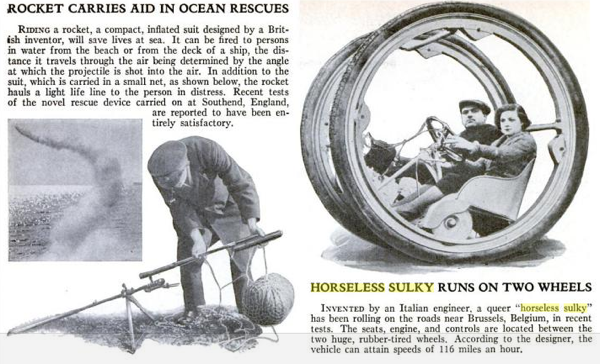
"Invented by an Italian engineer, a queer "horseless sulky" has been rolling on the roads near Brussels, Belgium, in recent tests. The seats, engine, and controls are located between the two huge, rubber tired wheels. According to the designer, the vehicle can attain speeds of 116 miles an hour." (Popular Science, pg. 19, 1935).

I would love to see photos of this thing being driven around Brussels.

In case you thought the Belgians were good for nothing but beer and international organizations, you can add totally useless transportation to the list. Do you think this is incredibly silly? Cause I sure do. Today's automakers, however, don't seem to agree.

Harley Davidson seems very enamored of the design, developing their own one-wheeled motorcycle:

S0v2y.jpg

(courtesy of Autoblog)

It appears that Bombardier has taken the design and simplified it even further, with the Embrio, which is hydro-powered and relies on gyroscopes to stay up:

HeU3B.jpg

Another variation of the "monocycle", the Wheelsurf, was premiered at Wired Nextfest:

UB0IE.jpg

I won't lie, I kind of want one. It tops out at 30 mph and sets you back around $4000. Which is a small price to pay to be transported STRAIGHT INTO THE FUTURE.

MorpHex Robot Exists Only to Terrify Us All

1 Comment »

NewImage

In case you thought the soft robot wasn't quite creepy enough, meet our new robot overlord: the hexapod.

Norwegian engineer Kare Halvorsen designed the hexapod, which appears at first like a giant ball, but then sprouts legs and walks (SO SCARY!). He details his process on his blog, which you should check out if you're interested in the technical process.

As of now, this robot can only put out, retract, and crawl. Next, Halvorsen is working on its rolling capabilities.

Watch it in action here (I assume there's a porno soundtrack to distract us all from THE HORROR!):

Historical Ephemera: Cargo Cults of WWII

1 Comment »

NewImage

Cargo cults are a fascinating phenomenon in pre-industrial societies that have come into and then lost contact with more technologically advanced cultures. The most famous ones sprung up in the South Pacific after WWII, but they've existed for centuries.

Islands in the South Pacific played a key role in the war between US and Japan, who frequently air-dropped food, weapons and other supplies to aid their troops. This cargo often ended up in the hands of the islanders. Then, as you can imagine, when the war ended, so did the cargo drops.

The islanders, by that time, had come to perceive cargo as the root of the Western and Japanese wealth and power, and ascribed the air drops to blessings for ritualistic practices. So what did these cargo cults do? They copied the soldiers.

NewImage

The built air strips, control towers out of bamboo and planes out of straw, and even mimicked airplane sounds in the hopes that, by following the "rituals" of the soldiers, they too would be blessed with cargo. They marched with bamboo spears cut in the shape of guns and carry American flags like soldiers on parade.

NewImage

In a nutshell, they went through the visible motions without taking into account any of the underlying principles. Some of these cults still exist today, most prominently the "John Frum" cargo cult in Vanuatu. (It is rumored that they named their cult John Frum after the frequently spoken introduction from soldiers: "I'm John from Cincinnati, John from Alabama" and so on.

Since then, the phrase "cargo cult" is frequently applied to both science and design. Richard Feynman defined cargo cult science as science that goes through the motions of scientific investigation without any critical thought. Similarly, cargo cult programming is defined by The Jargon File as:

A style of (incompetent) programming dominated by ritual inclusion of code or program structures that serve no real purpose. A cargo cult programmer will usually explain the extra code as a way of working around some bug encountered in the past, but usually neither the bug nor the reason the code apparently avoided the bug was ever fully understood.

Smashing Magazine has a great article about how "cargo cult" thinking has contributed to the slow erosion of creative design.

Best trivia of all? Serge Gainsbourg wrote a song about cargo cults!

"I know of the the magicians who call to jets
In the jungle of New Guinea 
They scrutinize the zenith coveting the guineas
That the pillage of freight would bring them

On the sea of coral in the wake of this
Machine those creatures not deprived
Of reason those Papuans wait for vapour
The wreck of the Vice-count and that of the Comet"

South Korean Prison Robot

7 Comments »

9yaJY.jpg

It seems fitting that since I've added an unofficial "robot" beat to this blog, there's been tons of exciting robot news and a visit to the wonderful Robotville festival at the Science Museum.

Of course, as with the soft robot, many new robotic developments seem just as likely to bring us to the robopocalypse as to a better society. You can file these new prison guards with the former.

South Korea is beginning a month-long trial of new robot guards, 5 foot tall machines designed to appear friendly to inmates. They're not designed to engage with the prisoners, but will report observations back to a human guard on duty.

The advantages are obvious: they're immune to prisoner taunting, they won't exploit prisoners, and they'll be unbiased observers.

However, I'm guessing they aren't terribly immune from that most basic thing that all prisoners will have access to: water.

The prototypes were designed by The Asian Forum for Corrections, in concert with Kyonggi University. And they assure us that "the robots are not terminators".

Isn't he cute?

NewImage

The Nasty Bargain We've Made with the Internet

5 Comments »

Bjy4x.jpg

I've been mulling over Jaron Lanier's "The Local-Global Flip", a rather long piece in Edge about the stated intent of the creation of the Internet versus the actual shape of it, 50 years later. The crux of his argument is that the Internet has contributed to the downfall of the middle class, because it has failed to monetize content creation, and doesn't reward us for the products of our minds.

I'm not yet sure how much I agree with the bulk of his argument, but two things really stuck out to me:

1. The Loss of Provenance

Did you know that the original design of the Internet didn't have a copy function? Seems mind-boggling now, doesn't it?

But, as Lanier points out, copying should be unnecessary in a functional network. The original content goes up, and then you link to it.

Now, because you can copy, copy, copy (or share, share, share), you lose provenance. Ideally, people link back to the original when they copy content, but of course they don't always.

The result is that new information or different information is lost in the vast repetition of content sharing, where you get a million articles saying exactly the same thing, because there is no copyright of creation on the internet.

If you produce a video for Youtube, your reward is that it's shared a million times. If you write a thoughtful analysis of a film or a book, same thing. The worst thing is, even traditional print media can still your work with impunity, and get paid for it.

2. We are not the consumers, we are the creators

Follow the money.

We are providing the data to Facebook or Google, and they sell our data to advertisers. Which basically means we aren't even selling ourselves, we're giving ourselves away to these data aggegators, who package us and sell us on without even our knowledge in many cases. What's more insidious is that we have, in fact, consented to this. It's right there in the terms of privacy in Facebook and Google+. We agree to give them the rights to everything we share about ourselves.

And we're not getting anything in return, apart from a great time-suck.

Youtube makes money off of selling to advertisers. We spend hours on mashups and supercuts and we give it to Youtube for free. Again, we're providing the content to make someone else rich, and without pay.

I'll conclude with Lanier's own words, but you really ought to go read the article and come back:

But in this case we have this idea that we put all this stuff out there and what we get back are intangible or abstract benefits of reputation, or ego-boosting. Since we're used to that bargain, we're impoverished compared to the world that could have been and should have been when the Internet was initially conceived. The world that would create a strengthened middle class through what people do, by monetizing more and more instead of less and less. It's possible that that world could have never come about, but that was never tested. If we are absolutely convinced that this third way is impossible, and that we have to choose between "The Matrix" or Marx, if those are our only two choices, it makes the future dismal, and so I hope that a third way is possible, and I'm certainly going to do everything possible to try to push it.

We're not going to be able to test tomorrow because we've gone down this path so far that it will be a decade's long project to begin to explore it, but we must find our way back. I wouldn't be surprised if it's a century after Ted Nelson first proposed this thought in 1960 that this is how the Internet should be. It might be a century before we even start to seriously try to do it, but that's how things go sometimes in history. Sometimes it just takes a while to sort things out.

Twitteruption HPV, and A Plea for Sense

4 Comments »

twitterfight.jpg

Another day, another twitter fight. These twitter fights have clear rules:

-The initiator clearly did not think through their initial post.
-The initiator takes offense when someone points out that they may have said something wrong.
-The initiatior heaps abuse on the rebutting commentator, and often draws in troops of followers to magnify the abuse so much that no one remembers what they're fighting about.

If you treat Twitter like your high school gym locker, you deserve everything you get thrown at you, even if I share your political/societal/media beliefs.

I'd tell you more of this particular fight, but unfortunately, I don't even feel right revealing who started the fight, given that the initial tweet violated someone's privacy in a frankly heinous fashion. (You can delete tweets hours after you write them, but an hour is a lifetime in social media. The damage is done.)

I'm not looking to turn this site into a gossip column ("Can you believe she said that?"). I'm commenting on this only because this is the third time this has happened this week. Three times now, there have been two people, who seem to be on the same side, who suddenly get into an argument and invent a fictional gulf that cannot be traversed.

In all three cases, the arguments ended with cat-calling, which is frankly embarrassing for the people involved, all of whom are respected political and/or feminist commentators.

In my more pessimistic moments, I wonder if all these new methods of connection and communciation are actually offering distant people more opportunity to abuse each other.

I also wonder if our increasingly uglier national conversations are seeping into personal conversations, normalizing abuse and unfounded accusation and responses made out of anger.

You see, I've always felt that part of the magic of the written word that you can edit out the insults, you can trim the fat and excess, you can reduce your response to the most naked poison if you choose to, and you can do so without cheap insults or expletives.

You can lay out your argument logically and persuasively, and you don't need to demean yourself in the process.

Would anyone have put down Jonathan Swift's "A Modest Proposal" because it was vulgar or rude? Of course not. They would have read until the end, and then, maybe, realized they should be offended. That's what writing is. It's a sleight of hand.

Even with hot-button communication methods like twitter, there's always a hesitation before you press enter; if not, there should be.

What burns me is something my mother has told me again and again: you can be saying the right thing until you're blue in the face, but you have to say it the right way, or no one will listen to you.

It really burns me (every pun intended!) that we really ought to be having a national conversation about HPV; women in this country need objective information about how you get it and what can happen if it goes untreated. But namecalling and saying that "Well I have HPV and cervical cancer and therefore I should have the loudest voice" doesn't help anyone. It just tunes people out, and it makes them less receptive to the facts.

Introducing New Comments System

1 Comment »

Howard.png

Right folks, I thought this process would turn out to be simpler than it actually is (this is the internet after all, and nothing is as simple as promised, but that's why we love it so. Right?)

As comment frequency has increased (a very happy thing!) I've become very dissatisfied with the default comments system, and others have reported problems with it as well (especially when they write long, thoughtful rebuttals to insane Doctor Who theories).

So I've moved to Disqus comments, which allows replies to be nested (amazing!), and you can subscribe to replies to your comment instead of to the whole thread (woohoo!).

But, Disqus is having problems importing old comments. Don't worry, they haven't been deleted, but it may be some time before I can restore them.

I hope this facilitates greater conversation moving forward!

Not Your Grandma's Recipe: 10 Minute Ratatouille

6 Comments »

MD17Ratatouille1024x768.jpg

The other day, I found myself volunteering to make dinner for a couple of people with about an hour to decide what to make, make it, and clean the flat. No small task. But I had a giant eggplant in the fridge, and a zucchini. A plan was born.

I've experimented with ratatouille before, but this is the closest I've gotten to perfection, which means that the focus is on the flavor of the vegetables, baked into submission.

You won't believe how easy it was.

Ingredients:

  • 1 cup tomato sauce
  • 1 eggplant
  • 1 zucchini
  • 1 potato (normally it's red pepper, but I think potato gives a nice texture)
  • 1 onion
  • 4 cloves garlic
  • Salt
  • Pepper
  • Whatever Seasonings You Want (CHILLI FLAKES, CHILLI FLAKES)

Instructions:

First things first. Prick the potato all over, then cook it in the microwave for 4 minutes. While it's cooking, we'll prep the other ingredients.

First, pour a cup of tomato sauce into your baking dish. (Here's an easy tomato sauce recipe if you don't have your own version).

DSCF0395.jpg

Then, thinly slice onion and garlic and layer it in the sauce. Don't worry how thin you slice the garlic, I know that can be challenging. Of course, there's a no-fault technique from Goodfellas you might find useful:

goodfellas_garlic_300x171.jpg

Of course, if you choose a cutthroat razor, you must also curse like a sailor for the rest of your cooking experience. And possibly murder someone...but I digress.

Ratatouille Step 2

By this time, your potato will be cooked, so take it out. Then, score your eggplant and microwave it for 4 minutes. (You can skip the microwaving in theory, but I think it improves the final texture.)

While you're waiting, thinly slice your zucchini and potato. I'd leave the skins on to get the full effect of color. (also known as wash your vegetables, kids).

Now here's the fun part. Once you've sliced your eggplant, you get to start layering, like so:

DSCF0398.jpg

Keep going round and round, then come into the center. You'll find, as I did, that the veg will stand up once the pan becomes more full. When you're done, it'll look like this:

DSCF0400.jpg

Pretty, no? The tomato sauce displaced itself to the top. As you can see, I sprinkled chilli flakes all over, but you can season it how you like. Salt and black pepper is standard, then go nuts. Don't forget to drizzle a little olive oil.

That's it! Stick it in your oven. It'll be done after 30 minutes, but if you can wait for a full 45, the veggies will reach the height of their flavor power. I threw breadcrumbs on top halfway through the baking, but that's optional (and totally non-standard).

Et voila! With minimal effort, you too will get top ratings from Mr. Ego.

DSCF0404.jpg

Civilization in Retrograde: Google Scribe

3 Comments »

DW-scribe11.png

I don't generally buy in to the frequently posited theories about how the Internet is making us more stupid, but this new Google feature definitely aspires to reduce our thinking.

I logged into blogger as usual (by the way, the blogger re-design is the most horrendous thing I've ever seen. It may be prettier now, but it's totally useless, especially when you're working on the coding of the xml template.) There was this exciting bit of news:

"Introducing Google Scribe in Blogger."

Hello Bloggers! Do you ever find yourself writing slowly, staring at a blinking cursor or looking for words to express yourself? Today we are happy to announce the availability of the text suggestions and autocomplete feature of Google Scribe, which is graduating from Google Labs and can now be found in Blogger in Draft.

Google Scribe helps you write more efficiently by suggesting common words and phrases as you type. Google Scribe supports Arabic, Dutch, English, French, German, Hungarian, Italian, Polish, Portuguese, Russian, Spanish and Swedish. The language is automatically detected using the text in the post.

So, for you, dear Reader, I reached out to test the product, and I simply do not understand it's existence. As my previous post was about River Song, I started with that, and ended up with this, based on following the autocomplete suggestions and inserting random punctuation:

River Song is the best way to get the best of the best in the world. When the user clicks River and the surrounding area and the second is the number of the first and second portions of the first and second, the third quarter of the year and the year of the study was to determine the effect of the drug.

Yes, the phrases and words suggested are vaguely human, but only in the sense that Mad-Libs are human.

I fundamentally disapprove of the notion that Google will write your post for you (if you don't like writing, why the hell are you blogging?) but this new trick beggars belief. Of all the useful things Google could do to improve Blogger (better photo placement controls, page templates, etc), they did this?

I believe 30 Rock provides the most logical explanation:


The Least Effective Way Possible To Combat Misogyny in Gaming

No Comments »

a-battlefield3.jpg

Well this is dumb. A large gaming club holding a LAN party in Texas, scheduled to celebrate the launch of EA's Battlefield 3, have decided the best way to stop female gamers from being verbally abused is to not allow them in.

“Nothing ruins a good LAN party like uncomfortable guests or lots of tension, both of which can result from mixing immature, misogynistic male-gamers with female counterparts,” the organisers originally wrote in an event FAQ. “Though we’ve done our best to avoid these situations in years past, we’ve certainly had our share of problems. As a result, we no longer allow women to attend this event."

Um, hello? So this group has elected to privilege the "immature, misogynistic" morons over, for instance, policiing that behavior? Needless to say, this kicked up a shitstorm, forcing the organizers to replace the post with something even sillier:

“This event is a ‘gentlemen’s retreat’; as such we do not allow women to attend.”

Gentlemen! I assume they're referring to the same sort of couth male who attends "gentlemen's clubs."

Then, that was replaced again, by:

“We actively discourage gamers from being the kind of mysogynistic jackwagons seen in the Reddit post, and such behaviour should not be tolerated. Frankly, we don’t like that kind of player either. So far as this event goes, it is an special event designed specifically for male gamers. Further, it is meant as a getaway designed to help said male contingent become better men both for themselves and for those who love us.”

Now there are a hundred things wrong with that. One, there original post shows that the organizers do not care to "actively discourage gamers from [...] misogynistic jackwagons." In fact, they are creating a safe space for them to behave that way without consequences. I'm not making that up, it's there in the original FAQ. "We don't like sexist jerks, so we're making this a special event, just for them." Secondly, I don't think I have to go far out on a limb as to say that both "themselves and the ones who love us" will all be present at that party.

The organizers are well within their legal rights to exclude anyone from their private event, but this sort of behavior leads to one unfortunate, likely erroneous, conclusion: the type of people who'd enjoy this game are immature, misogynist jerks, and this game brings out the worst of that behavior. This is probably not true, but these assholes certainly make it seem that way. If I were EA, I would formally distance myself from this group.

Why Twitter Should Not Raise the Text Ceiling

11 Comments »

tweeties_free_twitter_icons1.jpg

I don't know what it is, but so many mainstream magazine-style media publications write about technology from the perspective of old people trying to figure out what the kids are doing these days.

The latest screed in the MSM is that Twitter is going to lose all its customers if it doesn't increase the 140 character limit. To all of you I say: if you cannot write coherent thoughts in 140 characters, YOU ARE TOO VERBOSE. Just because David Foster Wallace wrote page-long sentences, that doesn't mean you can or should. In ANY medium.

The beauty and utility of Twitter comes from its brevity: in quick short bursts you can find information you need on topics you're interested in. You're not meant to be writing sonnets on Twitter, only haikus.

Here are a few reasons why Twitter should under no circumstances raise the text ceiling:

1. Twitter, at its essence, is a stream of headlines about real-time news.

That news may be where Neil Gaiman's speaking tonight, who's censoring the internet in other parts of the world, what feminists are protesting these days, or even what Ashton Kutcher had for lunch. But no matter how carefully you curate your following list, people will post things that are not relevant/interesting to you. And reading 140 characters disinterestedly is not something most people are too bothered about. 280 characters on the other hand? 560? This'll put us in Facebook nuisance territory.

Wanna write a complicated argument in your tweet? Blog it and post a link. If you can't keep it to 140 characters, but don't want to write a full blog post? Write two tweets. If you don't wanna do that? Reconsider how important something is if it can't be pithily expressed in 140 characters, but is not interesting enough to write a full post.

2. 140 characters is not arbitrary:

SMS text messages are 160 characters, which basically allows your handle and another 140 characters. The canard that "no one uses SMS anymore," is stupid and Western-centric. PLENTY of people use text messages to interact with twitter, myself included. You know who else uses text messages? Activists whose political speech has been censored by every other medium. People in disaster scenarios who can't pick up an internet signal. You know, the bread and butter of social media these days. The people who made social media something more than frivolous entertainment.

3. Twitter is not a chat program, no matter how you choose to use it

One of the most frequent complaints about twitter is that you can't hold a linear conversation on it. Not only is it untrue, it's a patently stupid complaint. Twitter lets you write "in reply to" a comment directed at you. Third party clients let you view entire conversations on one page.

If you want to have long, in-depth conversations that track back in a linear fashion? Allow me to introduce you to this wonderful new technology known as...no, I'll let Don Draper introduce it:

dondraper.png

In fact, I don't think that there's a single argument against twitter that can't be countered by Don Draper's words there (my words, his face, but who cares).

IN SUM:

1. I defend your right to inanity, as long as you KEEP IT SHORT. (I'll still unfollow anyone who so much as mentions a Kardashian, however)

2. Again: If you can't summarize a thought in 140 characters, your thought is probably ill-conceived and lacking in clarity.

3. If twitter really bothers you so much, DON'T USE IT. Enjoy the overload at Google Plus or the endless photographs of cats on Facebook. Leave me to my beautiful information exchange.

There's my polemic. Argue with me in the comments.

Recession Busting Recipes: Grilled Sweet Potato with Carrot-Onion Salad

No Comments »

sweetpotato.jpg

Recession Busting Tip #1: Keep the Ingredients to A Minimum.

When I first started cooking, it was really easy to be suckered into thinking the more ingredients a recipe involved, the better the result.

But lately, I've been obsessed with main dishes that focus on one ingredient. Not only do you get to take full advantage of the full flavor of the star vegetable, you don't end up with ingredients rotting in the fridge because you need a handful of this, a teaspoon of that.

Now that I have a basic, inexpensive spice collection, it's never been easier to whip up simple and tasty dishes.

Today's feature is the ever-delightful sweet potato. Now this vegetable is tasty no matter what you do to it: grill it, roast it, stir fry it, fry it, caramelize it, dance on it, and so on and so forth (maybe not the last one, but hey).

The main thing you need to be mindful of when cooking with the sweet potato is balancing out the sweetness. (I may be Texan, but that Thanksgiving concoction with sugar and marshmallow and pureed sweet potato is a crime against humanity. BLECH!)

(this, altogether, SERVES 2)

GRILLED SWEET POTATO WITH CARROT-ONION SALAD

Sweet potato ingredients:

  • 150 gm. sweet potato, basically one large sweet potato, peeled and sliced into approximately 1/4 inch slices
  • 2 tbsp. yogurt
  • 1 tbsp. cumin powder
  • 1 tsp. coriander powder
  • 1 tsp. red chilli powder (more if you like it spicy)
  • 2 garlic cloves, minced finely
  • 1/2 inch piece of ginger, minced finely
  • 1 spoon of olive oil
  • salt to taste (1/2 tsp is usually about right)

Instructions:

  • Mix all ingredients apart from sweet potato in a bowl. If you don't have yogurt, use sour cream.
  • Add in sweet potato and let marinade soak in for about an hour.
  • Now here's where things become optional. You can shallow fry the marinated pieces for a more intense flavor, but the healthier option is to grill/broil them. Either way, flip after about 5 minutes and cook both sides until dark brown.

Salad Ingredients:

  • 3 carrots, grated
  • 1 onion, thinly sliced
  • Juice of 1/2 lime or lemon
  • 1 minced green chili
  • 1 tsp. salt.
  • IF IT'S ON HAND: a bit of chopped cilantro
  • OPTIONAL: handful of peanuts

Instructions:

  • Mix it all together. For those of you who are afraid of raw onions, the lime/lemon juice softens the bite and takes away the edge.

That's all! Serve the grilled sweet potatoes with salad on the side and enjoy!

21+ Google Circles You Definitely Should Use

4 Comments »

4e1e439d9bc2f.png


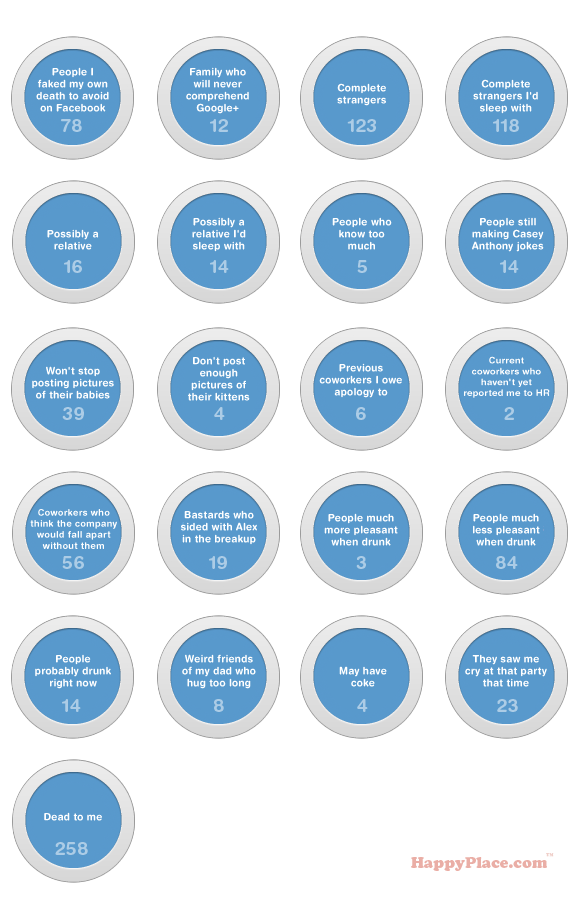
(c/o Happyplace.com. Clicking image will take you to original site)

The Only Time I'll Write About Soccer (Probably)

No Comments »

US-Womens-Soccer-Team-beats-Brazil-.jpg

I'm not what one would describe as a sports fan. But I do have a heartbeat.

Every step of the way, I have been moved and awed by the U.S. women's soccer team and their fantastic run to the FIFA World Cup championship finals.

It hasn't been easy. Inspiring a whole legion of Americans who don't watch soccer and probably don't even understand the rules, Americans ranging from teenage girl to soldiers in Afghanistan, just never is. But it's slow season for sports, and these women have taken the chance to show America how awesome they are.

Did I mention I have a heart? It swells just thinking about Abby Wambach's impossible goal against Brazil, a superhuman display of inner strength that occurred literally at the last second, sending the match into penalty kicks and eventual victory.

So what makes this different from any other under-dog story? Easy. It's the women we're watching and cheering on and yelling at our televisions for. And it is pretty cool to see muscled Army men punching the air for a bunch of women.

On Sunday, the U.S. team faces a tough match against Japan, another team with an extraordinary journey to the finals. I'll be rooting for the U.S., but I am telling the absolute truth when I say that it doesn't matter who wins.  It doesn't matter if you don't know a sweeper from a striker, offsides from out of bounds. All that matters is that you grab a few brews, round up a few friends, and get ready to get rowdy.

Initial Thoughts on Google+

9 Comments »

b-emerald_sea.jpg

In A Sentence:

If Twitter and Facebook had a baby, and that baby was much prettier than Facebook but not nearly as cool as Twitter.

In A Few More Sentences:

There's a child-like joy to the actual experience of setting up google+: you drag people into circles, and if you're particularly inclined (I am so inclined) then you can imagine you're creating your own version of Dante's Inferno (yes, I am aware how sinister it is that I am sending all my friends/acquaintances to Hell. Rest assured, other contacts have created far less family-friendly monikers for their circles).

But I digress.

The most important thing here is that G+ is providing a real competitor to Facebook. We were this close to total monopolic consolidation on the Internet: Google as the only search, Facebook as the only "friends" sharing system*, Amazon as the books-opoly, and so on. It may not seem that Google going up against Facebook is the biggest shake-up in online power, but we all know that competition is what leads to progress, to better consumer experiences, to better products.

While I feel that tech savvy (particularly Internet savvy) people are going to latch on to the new service, I think it poses problems for more average users (I partially consider this a positive. For instance, your grandma won't be using google plus). Setting up a profile took a few steps too many for my liking. The often touted privacy features felt removed from all the other account settings (they were in no way obvious), and even simple settings for key G+ features like +1 required leaving the G+ interface and moving back into the main Google account settings.

But what is it for? Twitter took a long time to reach critical mass, because it's added advantage wasn't clear for a very long time; people thought it was just a streamlined Facebook wall for a long time. Google has already proven itself untrustworthy when it comes to protecting dissidents when government push comes to court-ordered shove. I suspect we'll learn more about G+ utility when the business pages come out later in the year.

A Few Suggestions to Make Google Plus Better:

Allow the creation of Venn Diagrams, so you can see how your networks interact (this isn't actually useful, but it sure would be fun. I can see the rom-com now: "The Man at the Center of my Googleverse").

Make it easier to find friends. Specifically, allow imports from twitter. Right now, if people don't have a google mail account, you can't search for them (and sometimes you can't find them even if you do).

Why isn't G+ integrated into Google Reader? I would enjoy +1-ing interesting articles, BUT I CANNOT.

Final note:

That image at the top? It apparently inspired the whole project. Google had it emblazoned across the walls on the fourth floor of their offices.

*I'm not including twitter in this because it really is a tool, not a destination. It enables communication, unprecendented activism, and lightning speed information sharing. It's simplicity and basic use is its best recommendation. It's not competing with Google+.

Powered by Blogger.