THE CLASSICS
It's been a great year for me and the classics. It's frankly ludicrous that I haven't seen some of these before, but hey, now I have lots of material for the dormant Filling the Gaps series. In every case, it's been easy to see why they're in the canon; they still seem to provide points of reference for many modern films (generally because they're better crafted).
I went through a phase in 2005 when I tried to watch all the movies on AFI's top 100 movies list (released back in 2001 if I recall correctly. And no, there's no such thing as Google). I made it to On the Waterfront and quit. Not because it wasn't terrific, which it was (That song lyric from "Rattlesnakes" finally made sense: "She looked like Eve Marie Saint, in On the Waterfront.") But the real issue was, 2005 was my last year at the good old University of Texas. And probably the year I had the most fun, and also the least time. Which basically meant that blocks of stationary hours for films were not given much priority in my schedule (much being relative - I think I still managed about 20 movies that year).
THE SUPERB
Chinatown was the first movie I saw after questioning the internet gods: "Hey [insert google/imdb/cinematical.com/davidbordwell.net] what movie do critics and movie fans seem to refer to all the time that I've somehow been deprived of seeing?" I saw it six months ago, and even now, certain images from the film seem to manifest in my head when I least expect it. It's not difficult to draw a line between Chinatown and this year's Somewhere: both Roman Polanski and Sophia Coppola managed to uncover the contradictions and the ugliness of California, that shining state universally considered a kingdom of glamour.
Most of the time, when there's a particular 'classic' that I haven't seen, there's a reason. Not necessarily a good reason, but reason sufficient to create mental blocks. There wasn't one for The Godfather. To this day, I'm still not sure why I'd never seen it before. But I finally did, and was treated to a healthy combination of warmth, humor and violence (this seems to be the magical troika that Hollywood has been searching for ever since, and achieved only rarely).
THE NECESSARY
This category of 'necessary' was created purely for one movie: Sunset Boulevard. You know when people talk about movies being 'important,' and you wonder what the hell they mean by that? Watch this movie. It's a touchstone for so much that has come since, which is especially striking since it's a tale of transition about what came before, when silents were thrown out in favor of talkies.
If the world ends tomorrow, and alien archaelogists want to understand what the 20th century (and probably 21st century) obsession with movies was all about, they just need to see this movie. It has everything: the conflict between art and money, the fear of getting old, bizarre and total subservience to celebrity, the banality of eccentric obsessions, and the cruelty that comes from delusion.
The real reasons I'm glad to see this movie? One, 2010 was the 50th anniversary of All About Eve, and apparently a favorite critical pastime is to compare the two (I think it's apples and oranges, but whatever). Two, it reveals Black Swan for being the superficial and incoherent b-movie that it is.
THE GUILTY PLEASURES
I saw Notorious well after I started this blog, but for some reason I couldn't write about it. I think I loved it too viscerally, even though there were problems with the narrative. So I employed a childish solution to this intellectual conflict - I covered my eyes and went "It's not real if I can't see it! It's not real if I can't see it!" And if I think about it enough to write about, then I'll see the flaws and cracks. And I don't want to. Because I loved it. A lot. I think it has my favorite ending of any movie ever.
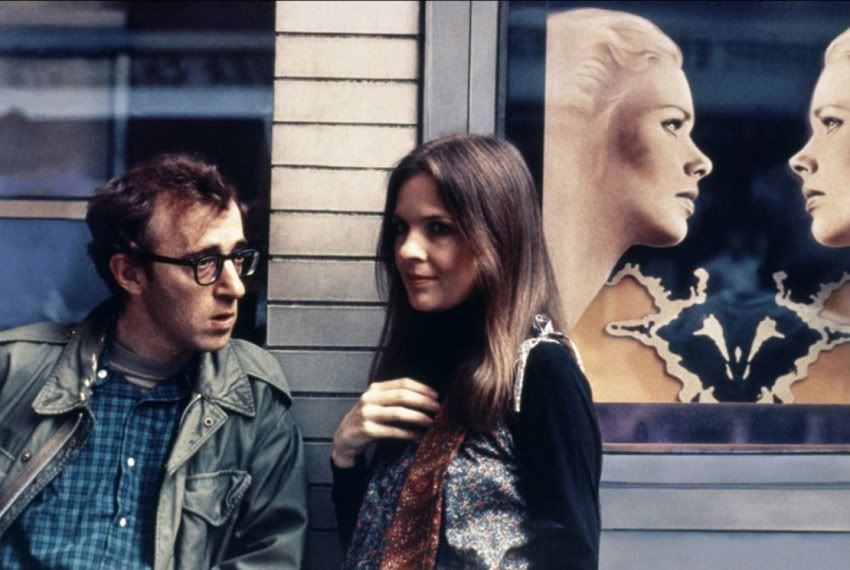
It may seem counter-intuitive to put Annie Hall under the heading of "Guilty Pleasures," but it seems that in my generation, you do feel like you have to justify why you would watch (let alone enjoy) a Woody Allen movie. But I maintain that so many movie tropes were actually created in this movie, and were effective at the time (albeit overused now). Also it's hilarious. See it now.
MODERN CLASSICS
I finally saw Shawshank Redemption, after rejecting it with every fiber of my being. You can read the original review to find out why. It was one of the less essential films I saw this year, except to check it off a list (and it is on many lists, for some reason I don't understand). But I wasn't bored by it, and Tim Robbins and Morgan Freeman kept things rolling along in an eminently watchable fashion. I also liked that there weren't easy answers in it, and that when this movie came out, that was still acceptable. (The counterpoint to this is The Kids Are All Right, where many are turned off by the ambiguity, but I tend to think ambiguity makes drama more honest.)
The other modern classic 2010 gifted me was Wall Street. Watching this became necessary, as I realized that it may be another few years before this particular version of douchebaggery becomes relevant again (and oh, how relevant it is to the past year). Wall Street provides strong insight into the mentality of a certain type of financial professional - the ones that pursue money, more money, at any cost. While a lot of the chicanery used in this film died when the internet came along, it's not difficult to imagine this sort of manipulation is still bubbling along under the surface, harder to trace.
LOOKING FORWARD
It's great, I feel like I've crossed some longstanding obstacles, and now I can get into the real oddities that dot the history of film (to be honest, I think I skipped straight to the oddities and passed the canon by. See, for example, my unending love for Belle de Jour and other Luis Bunuel exotica. Actually, Belle de Jour is another example of what Black Swan tried to be and yet failed miserably. It seems that trashing Black Swan may have become my new I Hate Garden State. But to be fair, this time it's not Natalie Portman's fault.)
I've already got a long list of classic films to look forward to: just over the next couple of weeks, I'm planning to get through The Leopard, Meet John Doe, Lady Eve, and many Bette Davis films. I've also got sequels to look forward to. But I think 2011 is going to be a great year for me and classic film.