Great Effing Novels: Mockingbird by Walter Tevis

No Comments »

NewImage

In brief: I have one thing to say: Mockingbird is one of the best novels I've ever read. I never thought I'd be moved to say such a thing at my age, but there you go. The rest of this review goes into why, but the point is simple: read it, then talk to me about it. It also corrected my belief that no one could read anything original about New York City anymore.

Walter Tevis also wrote The Hustler and The Man Who Fell to Earth, and despised both adaptations.

The Full Review

When you know that humanity's coming to an end, what would you want your legacy to be? These are the thoughts that drive us; we pretend to be concerned with a bigger picture, but that view tends to sit just out of reach, something we strive for but never achieve, trapped as we are in our own petty quests.

What if your single driving goal in life is to die? That you want this one thing so badly that every decision you make services that desire, with no regard for consequences to others? That's the question that Walter Tevis' Mockingbird asks. What depravity would that desire drive us to, and how will we mutate if we can't succeed?

Walter Tevis' Mockingbird overflows with character. Dystopian fiction, especially the kind designed to stimulate "big ideas about the dangerous direction society is headed", doesn't tend to concern itself too much with people ("big thoughts" being the operative concept).

Think of 1984 or Brave New World or even Yevgeny Zamyatin's We: there's a male lead who's notable for his very inhumanity, and some female who spurs thoughts of "zomg my desire to act on my desires for love and sex will set me free even if they kill me for it!"

If I'm being reductive, it's with reason. These women are objects; the science fiction equivalent of the manic pixie dream girl saves our hero from a life of total conformity.

But in Mockingbird, there are no heroes, just people striving to be human, which is a heroic enough feat. Because no one's elevated to being more than they are, the characters are actually allowed to breathe: we know Mary Lou, and we understand why she doesn't wait for Bentley (which is a thing every other woman in every other fucking dystopian novel would have done, or felt tortured for not doing).

Not just people; robots too. Spofforth the philosophical android is unique enough: you never forget that he's a product of cold human design, yet he still evolves into a peculiar personhood of his own. Did I mention he's black? A black fucking android roaming the streets of New York City, distracting the world with his perfect physical form while trapped in the darkness of his own driving ambition.

He makes so many bad decisions, like any good human. And yet his value his clear. You see what happens to the world when he stops paying attention. The real answer? It doesn't fall apart, but he feels it does. That's not a human feeling at all.

Mockingbird's world came to be not because of outside concepts like technology and politics, but from human mistakes (if you think that's a weird statement to make about a robot, you haven't yet met Spofforth). The tension between a desire for privacy and a desire to be part of something bigger than oneself drives much of the narrative.

But I've just spent a lot of words to say one simple thing: read this novel. You will love it. The end.

On Apple's iOS 7.0 "Refresh"

No Comments »

NewImage

The office put up Apple's WWDC keynote on a giant projector screen, and hilarity ensued (and swiftly turned to horror). Five comments from work that perfectly capture the complete and total awfulness of Apple's new iPhone operating system:

  1. Person who casually walks into kitchen, unaware of what's onscreen: "Oh hey! What's that on screen? Is that Android?"
  2. Apple fanboy, slowly deflating: "Didn't the Nokia phone fail?"
  3. Smug Apple-hater: "It's like they kidnapped the designer of the Windows phone."
  4. Bewildered so-and-so: "Did Apple buy out Yahoo so they could steal the design of the Yahoo!Weather app?...And make it worse?"
  5. "It's funny that they're making album covers so prominent. You know who taught me not to look at album covers anymore? ...iTunes."

You may detect a common theme in these remarks (which are closer to verbatim than you might think): there's nothing remotely original about this design. It cobbles together aesthetic ideas that have existed for years in various smartphones, failing to tie them together into a coherent whole (and let's face it, this is what Apple used to do best).

It's possible that this is a functional problem with the technology of the smartphone itself. Think about it; the iPhone debuted almost 7 years ago, and hasn't really changed interaction. What devices have stayed so static? Even with dumb phones, every year there were new ways of interacting, from standard buttons to touchscreen buttons to horizontal keyboards to different kinds of screens entirely.

The technology is stuck and so the design is stuck. Which brings me to the greatest shortage in my industry today: creative hardware developers.


The Peculiar Orientalism of The Orphan Master's Son

No Comments »

Orphan Master's Son

Have you ever consumed an Eton mess? A popular English dessert, it earned its name from looking like what remains after a bunch of teenage boys beat each others' brains out and then have a drunken orgy with a dingo.

But it's delicious, and you can't stop eating it, even though the Oreos and the strawberries battle each other with textures that feel similar but don't fit together in any way shape or form.

Ahem. I'm hungry now. Anyway...

If you take two steps away from Adam Johnson's The Orphan Master's Son, it looks like a fucking mess; it moves from cold gritty realism to picaresque fantasy to delusional fiction (which, ironically, is a dangerous quality in a work of fiction) without bothering to clue in the reader.

When it succeeds, it ruins you so bad that you feel cowardly for even wanting to look away. 90% of the novel falls into that camp. But Johnson disrupts the flow too often with cheap (and insensible) tricks that leave you questioning any truth in the world he fashions.

I imagine any discussion of North Korea has that problem: all we know about that country is how much we don't know. But think about constructing an entire nation from the views of the ones who choose to defect. If the United States were suddenly closed for business, how might Texan secessionists describe the country?

This is what The Orphan Master's Son struggles with. As Barbara Demick said in her own review of the novel:

"People are inclined to believe whatever outrage they read about North Korea, but bad as it is, I've not heard of political prisoners being lobotomised with nails inserted over the eyeball or with electrical charge."

And this is where it hurts to be such a structural mess. If the narrative kept focus, you can overlook the muddy details and choose to follow the highly compelling story of one Jun Do (whose homophonic resemblance to John Doe is no accident).

I love science fiction, so I'd never belittle a setting for being imaginary. But the fact remains, this is not science fiction. North Korea is a real place, with real people. Crafting a dystopian view of a mysterious place seems like an impossible talk; for a dystopian novel to work, you need to understand the society it critiques.

Choosing to set this work of fiction in a place you know nothing about (and don't pretend taking one trip for a couple of days in a highly controlled environment tells you anything about a society) smacks of orientalism of the worst kind. All our knowledge is based on what we imagine their lives are like, which erases any space for true humanity.

Doctor Who and the Rings of Clara-khenaten

3 Comments »

NewImage

I know that the latest episode of Doctor Who seems a bit slight on the surface, but like Gridlock, which had a number of thematic similarities, there are joys to found in the depths. It's been a long time since I could describe this show of having any subtlety whatsoever, but even while maintaining the usual loud tempo in the A-plot, the episode still offered little reveals about the Doctor, and more importantly, about Clara.

Despite the fact that this episode centered on the loss of a parent, there wasn't a big emotional crying scene. I've realized more and more that when the characters' histrionics overwhelm the scene, there's no room left for the audience to connect emotionally.

In just ten quiet seconds, we feel the weight of the moment when Clara's forced to give up her mother's ring. The Doctor asking her to make that sacrifice clearly plants a seed of doubt in her mind about him, and reminds us that no matter how much he walks the walk, he's not actually human.

Nor do we need a big dramatic scene to understand the significance of the fact that when asked for a physical totem of cherished memory, he can only offer his sonic screwdriver. That's even though he once brought his (assumed long dead?) granddaughter to this very place.

(And because you should see it if you haven't, the scene where the Doctor abandons Susan on Earth for Not!AdamScott is one of the loveliest moments of the classic series. Middleman did a riff on this scene, for those of you who enjoy such things).

I've heard it said on Twitter that the episode relies on the usual Doctor Who deus ex machina that is The Power of Love. For once, I think there's something far deeper going on. Clara doesn't feed the monster with love, but with the infinity of loss. It's neatly scientific, wrapped up in a human bow. People who are grieving don't tend to dwell on moments had, they think of moments missed, moments lost. Every time I miss my grandmother, for instance, I don't think about my youth spent with her, I think about how she isn't here, how she isn't sitting next to me, enjoying Doctor Who with me (and enjoy it she did).

There's an infinity of those moments, and you'd go crazy if you try to understand how enormous those missed moments are. No one can comprehend infinity. You just shut down when you go too far down the path.

Which is my long-winded way of saying, well done Who, for having an vaguely comprehensible ending for once.

OTHER STUFF:

Clara Clara Clara. SO MUCH LOVE. She's the first companion in the New Era who I'd actually want to meet, and can imagine myself befriending.

NewImage


Kate Atkinson's Life After Life

2 Comments »

Screen shot 2013 04 01 at 11 40 17 AM

Imagine someone writing the novel described in Borges' Garden of Forking Paths. You lead a hundred different lives in parallel.

You're born, and then you die. You're born again, and then you die again, after ticking off a few more minutes of your lifeline. By the time you've met your hundredth death, you're old enough to understand what's about to happen. You may not always interpret the signs correctly this time, but you'll learn. Sometimes you learn when the wrong person dies. But at least you get another chance.

Our heroine, Ursula Todd, is duly plagued, which results in her taking on multiple fates, each of them tiny microcosms of the human experience: so much horror, so many delights. It's not so simple as Sliding Doors, we follow her through two wars, and many traps lie afoot. Some of her worst experiences have nothing to do with the war. Humanity's usually its own worst enemy, whether you're in bucolic England or in mid-war Germany.

These are difficult themes to maintain, and I'm still impressed at what control Atkinson held. Astonishingly, even through reset after reset, there are character through-lines that remain both consistent and heart-breaking. The lines around Ursula's life are so beautifully colored in that the reader can dive easily into each new storyline, at least once you get used to the conceit.

"Darkness falls, and so on."

But what will probably stay in my mind, once all the timey-wimey trickery fades into the distance, are visions of a ravaged London, a London so thoroughly decimated that the descriptions read like science fiction or dystopia.

She was cold. The water she was lying in was making her even colder. She needed to move. Could she move? Apparently not. How long had she been lying here? Ten minutes? Ten years? Time had ceased. Everything seemed to have ceased. Only the awful concoction of smells remained. She was in the cellar. She knew that because she could see Bubbles, still miraculously taped to a sandbag near her head. Was she going to die looking at this banality? Then banality seemed suddenly welcome as a ghastly vision appeared at her side. A terribly ghost, black eyes in a grey face and wild hair, was clawing at her. 'Have you seen my baby?' the ghost said It took Ursula a few moments to realize that this was no ghost. It was Mrs. Appleyard, her face covered in dirt and bomb dust and streaked with blood and tears. 'Have you seen my baby?' she said again.

This London remains stuck in history. The art of the time had strict rules, propagandic overtures that wouldn't bear any mention of the idea that the British were so badly beaten down during the war.

You find this struggle most baldly acknowledged in the stranges of places: Gracie Fields comedies and in Powell and Pressburger's delicious allegories, especially in Black Narcissus. Just as Deborah Kerr's nun struggles against poverty, illness, crumbling infrastructure and burning desire in the remote Himalayas, millions of Brits struggled with the same at home. But one could never admit that; the Dunkirk spirit held its sway. Only in photography could you find the reality; was photography even considered an art then, or just documentation?

NewImage

Poetry and the visual arts gave way to the abstract; the human eye and the human heart were incapable, then, of processing the horror of being in constant danger of annihilation. Atkinson's choice, then, to draw out this most troubled time, to realize it in words, strikes you in the heart.

A woman wearing a mink coat had come out of the entrance to the Savoy, on the arm of a rather elegant man. The woman was laughing in a carefree way at something the man had just said but then she broke away from his arm to search in her handbag for her purse in order to drop a handful of coins into the bowl of an ex-soldier who was sitting on the pavement. The man had no legs and was perched on some kind of makeshift wooden trolley. Ursula had seen another limbless man on a similar contraption outside Marylebone station. Indeed, the more she had looked on the London streets, the more amputees she had seen.

A doorman from the hotel darted out of Savoy Court and advanced on the legless man, who quickly scooted away using his hands as oars on the pavement.

And so I found, not an answer, but at least an understanding of something that plagued me when I lived in London, wandering the streets and pondering the crazy mess of buildings that huddle up into some kind of city. When so much of the city is destroyed, why wouldn't you build it to plan for the future? Even after WWII, urbanization became apparent. Someone made the choice to rebuild so many devastated buildings as exact replicas of what they used to be, instead of acknowledging survival and moving on into the (somewhat)  brighter future.

A partial explanation ties directly into the novel; you can't see into the future, and no matter what you do, you're always trapped by your past. If only we all had the opportunity to direct our own garden of forking paths.

Charlotte Armstrong and the Case of the Weird Sisters

No Comments »

NewImage

When I recovered from the relentless terror of Shirley Jackson's House on Haunted Hill, I searched for another novel that flies out of the gate like a rocket-powered robin, whispering horrors in my ear with the loveliest of voices.

A re-release of Charlotte Armstrong's Case of the Weird Sisters fell into my lap, and more than made the grade. Armstrong maintains a a fierce commitment to suspense and character, even as certain aspects of the narrative fall flat.

Alice Brennan trips lightly through a poorly thought-out engagement into the house of the titular weird sisters, each nursing a debilitating handicap and a desperation for cash.

As I read it, 3 other series came to mind: Hercule Poirot, contemporary Doctor Who and a whole body of self-referential film noir.

These may sound unrelated. They're not.

Each case relies upon an interloper who not only happens upon the mystery, but also ingratiates him (let's face it, usually him) self with the primary players in the case.

I love The Case of the Weird Sisters unabashedly, even though it lays bare some of the most problematic aspects of the type of storytelling I describe. Doctor Who, despite being a science-fiction yarn, may represent this storytelling best: it relies upon the viewer relating to the earthbound narrator, who controls the story until the Doc appears. At which point, the Doctor takes over all agency, and our earthbound audience stand-in becomes nothing more than an observer.

NewImage

::experiences sudden worry that the Charlotte Armstrong reading audience MAY NOT crossover to the Doctor Who audience, but c'est la vie::

Armstrong belies this; Alice is the lead, through and through. In fact, you can practically sense editorial medding; the tale's too feminine somehow, starting and ending with her love life, so we have to introduce MacDougal Duff as the lead, even though he leaves five pages in, only to reappear at the 27% mark.

That's a sizable chunk of the novel, ample time to forget that Duff even exists. And when he commandeers the narrative, our emotional hook becomes less strong. He enters the scene without any real connection to the characters (his knowing Alice is a silly coincidence at best) and absolutely no stake in how events turn out - he can always just leave.

This sort of thing can be written off as a necessary evil in a weekly tv show, but in a self-contained novel, it's a curious choice, and one that robs the narrative of urgency. We want this to be about Alice. The eerieness of the House of the Weird Sisters perfectly reflects the cobwebs in her own mind. As she works to sweep them away, we want to be with her, not with the interloper.

All this notwithstanding, the novel was a great read, and I'd recommend it to anyone. Despite the weirdness of Duff's interruption, he's as entertaining as any of the other characters, and that's what saves the novel. Armstrong's greatest strength is crafting the atmosphere, and I have to say, I was sorry to leave.

NewImage

On the Veronica Mars Kickstarter

No Comments »

NewImage

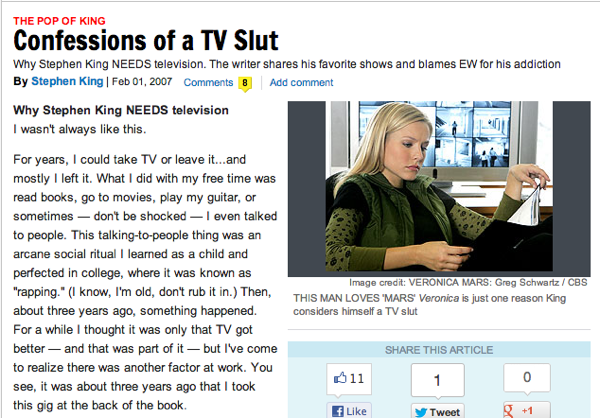
Duty dictates that The Oncoming Hope writes of Veronica Mars. For before The Oncoming Hope adopted a whole range of Doctor Who related aliases (aliasi?), all the internet handles (and the Oncoming fashions) were based on Veronica Mars (and as fans know, you can never just call her Veronica).

I actually can't believe I get to write about this show again. I discovered both blogging and fandom through it, and even though we obsessives eventually went our separate ways, we still run into each other in the darkest corners of the internet...

...or so it seemed.

For we were the few who watched the show when it aired.

But we do not begrudge those who found it after season 1, on the recommendation of one thriller writer whose name rhymes with Freven Ding.

Screen shot 2013 03 19 at 10 52 14 PMScreen shot 2013 03 19 at 10 52 36 PM

We do not begrudge the Whedon-ites who found the show after prominent guest appearances by Willow, Cordelia, and Numfar himself.

NewImage

We don't even begrudge the sorority girls who found the show after the CW cross-promoted it with guest appearances by Kristen Cavalleri (like...who?) and various other members of America's Forgotten Top Models.

But we do begrudge this:

Screen shot 2013 03 19 at 10 44 45 PM

Cause here's the thing about Veronica Mars. It was genuinely niche, a show for the geeks, from a time before geeks controlled the pursestrings.  Marvel hadn't yet assumed its disturbing stronghold on Hollywood and geek culture, Doctor Who was still that weird show on PBS with tinfoil aliens and styrofoam sets, and Star Trek wasn't even a lens flare in JJ Abrams' eye. So being the first to watch it is meaningless; there's never been any kind of mainstream push behind it.

Few watched Veronica Mars when it aired, but we desperately wanted all our friends to watch it. Even TWOP couldn't hide its unabashed glee (and this was when TWOP gave positive reviews to NO ONE (before it was bought out)) at this weird little show that was technically perfect and wonderfully plotted (read the season 1 recaps if you think I'm kidding; "glowing" barely scratches the surface).

So when I think about this Kickstarter, I don't think about it as a means for the WB to test out new production models, I don't think of it as surrendering some private nerddom to the mainstream, I think of it as what it is; a bunch of super fans had the chance to fund something they love. This beloved thing was never going to get any mainstream or institutional support. This is not Firefly, which had twice the ratings of VM when it aired, and already had its shot at a movie.

I think of this as a paean to what the internet used to be. When fandom wasn't manufactured, when it depended on a small group of people desperate to love and to promote the thing they loved. They didn't need to own it, they didn't need to feel like it was their own, they just felt that it was special enough to be shared.

And so it is. Every one of my close friends from high school and college eventually caught up to it, on the strength of my love for it. They love it too, and I never feel like their love is worth any less than mine; I just feel grateful that they gave it a chance.

This Kickstarter, no matter the implications, will connect more people with a show that they're likely to love. And for that, I'm grateful. And for the first time, I opened my wallet.

An Early Human Rights Editorial

No Comments »

ELT200801171805355470428

The United States Democratic Review must be one of the strangest publications in our nation's brief history. A strong proponent of Jacksonian democracy (and the ugliest aspects of Jacksonian democracy - annexation and manifest destiny), it also published work by a number of humanist and transcendental thinkers. Despite an editorial position that constitutes the worst of American jingoism, brilliant (and prescient) pieces, like the one below, snuck in.

I've referred to the original periodical, and cannot find an attribution. The logical assumption, then, would be that the editor wrote it, but its strong support of human rights, and the rights of a "lesser species", suggests otherwise. The Sepoy rebellion is a classic case of the victor writing the history - as far as the British Imperialists were concerned, it never happened. But to everyone else, the act was plain - one man killed a missionary, and the British army slaughtered 30,000 Indians and called it "civilized".

You don't need to look far to see recent incidents that mirror this. Anyway, read it and play along in the comments.

Abuses of Victory - British Morals in India (Dec. 1858, in the United States Democratic Review)

In exploring the annals of history, on almost every page is seen a record of the triumphs of one nation over another nation - of one race over another race. If this record is prepared by the victorious party, it is filled with exaggerations of the magnitude of its triumphs; teems with eulogy of the victors, and with detractions from the vanquished. If, on the contrary, the record emanates from the defeated party, a very different picture is drawn; then the pencil of the artist paints the character of the victors in deep crimson, and the pen of the historian draws black lines around their memory. In this manner successful brutality and force may be placed before the world in the light of heroism and patriotic achievement - sometimes even robed in the mantle of Christianity - while an unsuccessful effort to maintain the right, and defend the innocent, is stigmatized as barbarous and infamous; - and this is history. Prejudices as deep as these, it is feared, have controlled English writers in recording the events consequent upon the war of their country with India.

The history of that war, while it does but simple justice to the bravery of Englishmen, is a sealed book to the impartial truth of what has really been enacted in that distant country by British officers and soldiers. An occasional account of the doings of the English army in India reaches us through other sources than their own, and a recital of their deeds chlills the blood of the most cruel, as did the statements of the butchery by the infuriated Bengal Sepoys of foreigners who were in India at the commencement of hostilities.

The halo of glory that should have decked the brows of the heroic Havelock, Lawrence, Neill, and Nicholson, was dimmed by the blood of a hundred thousand defenceless natives in the subsequent conquests and brutalities by the British army. The wrath and indignation of the civilized world were justly aroused when the barbarous Sepoys waded through seas of Christian blood to secure the heads of two or three missionaries whom they regarded as their enemies; but no word of reproach is heard against the British soldiery when they form a catacomb of the corpses of thirty thousand Sepoys, whom they slaughtered in cold blood, for no other cause than that one of their number was guilty of a barbarous murder; and he had been delivered to the English for execution when demanded, but this could not appease their thirst for revenge.

Were the true history of this devastating war written, many barbarous exhibitions of this kind would be recorded to the shame of British victories in India. After conquering their degraded and imbecile foes, they assume or acquire the instincts of the blood-hound, and trail them wherever they flee, until the native soil of India is saturated with innocent blood - and this brutality the proud nation of Britain calls "civilized warfare. To use their own language, they

"Through SOFT degrees
Subdued them to the peaceful and the GOOD."

If the British historian who attempts to illustrate the humanizing and christianizing influence of the war in India, by the lines just quoted, was a mere satirist endeavoring to create in the public mind the most sickening disgust for the inhumanity and heartlessness practised by the conquerors of India, he coul d not find two lines better adapted to his purpose. "Through soft degrees" indeed - through the cannon, sword, rifle and the bayonet - they "subdued them to the peaceful and the good!"' Such hypocritical cant was never before employed by any writer claiming respectability, in discussing a subject of such solemn importance as that attached to the extinction of a nation, who, although not far advanced in civilization, were enjoying a large share of independence and contentment, until invaded by British rapacity, and by unscrupulous adventurers, who first sought their wealth, afterwards their liberty, and finally, their lives.

The writer referred to, and who penned the lines above extracted in eulogy of the British administration in India, admits that the nations, at least those inhabiting the country of the Five Rivers, were in the enjoyment, at an early period of their history, of a system of government well adapted to promote their interests as an independent people. He says, "Its form of government was a federation of chieftains, each independent of others, who met together at intervals to provide for their common safety, and furnish each his armed contingent for the public service."  Their motto was Wa Gooroojee ha Kalsa - Victory to the state of Gooroo. In their religion's creed they taught that all men were equal in the sight of God - that distinctions of caste were not a principle of faith - that differences of religion did not debar men from a common charity. Socially, they occupied a fair position,--industry and frugality were visible everywhere among them. This, in brief, seemed to be the condition of the people of India previous to being oppressed by taxes, and despoiled of their lands and their liberty by the conquering army of England, urged on by a ministry as false to its own nation as it was heartless and cruel to the inhabitants of India.

But it is not our present purpose to enter into a discussion of the merits of this war, nor would we have referred to it at this time, except for the fact that the latest advices from India seem to present a condition of moral degeneracy among the people, growing out of British influence and conquest, which is unparalleled in infamy in the the most barbarous ages.

H.G. Wells on Teddy Roosevelt on The Time Machine

No Comments »

NewImage

Why people don't talk about Teddy Roosevelt more saddens me. His biography is full of baffling and wonderful surprises (such as this incredible tale of reading and reviewing Anna Karenina while chasing bandits down a frozen river in the Dakotas).

For example, H.G. Wells (quoted from Edmund Morris's essay on Teddy in This Living Hand: And Other Essays):

He hadn't, he said, an effectual disproof of a pessimistic interpretation of the future. If one chose to say America must presently lose the impetus of her ascent, that she and all mankind must culminate and pass, he could not deny that possibility. Only he chose to live as if this were not so. He mentioned my Time Machine...

He became gesticulatory, and his straining voice a note higher in denying the pessimism of that book as a credible interpretation of destiny. With one of those sudden movements of his he knelt forward in a garden chair -- we were standing, before our parting, beneath the colonnade -- and addressed me very earnestly over the back, clutching it and then thrusting out his familiar gesture, a hand first partly open and then closed.

"`Suppose, after all,' he said slowly, `that should prove to be right, and it all ends in your butterflies and morlocks. THAT DOESN'T MATTER NOW. The effort's real. It's worth going on with. It's worth it. It's worth it, even so.' . . .

"I can see him now and hear his unmusical voice saying, `The effort -- the effort's worth it,' and see the gesture of his clenched hand and the -- how can I describe it? - - the friendly peering snarl of his face, like a man with the sun in his eyes. He sticks in my mind at that, as a very symbol of the creative will in man, in its limitations, its doubtful adequacy, its valiant persistence, amidst complexities and confusions. He kneels out, assertive against his setting -- and his setting is the White House with a background of all of America.

I always enjoy how nearly every account of meeting Teddy Roosevelt is narrated in the style of a seduction; he's a man who leaves a powerful impression on all he sees.

And besides, can you think of another President who would not only read but have thoughts about contemporary science fiction?

Oscarbait 2012: Silver Linings Playbook

2 Comments »

Url

Silver Linings Playbook earns its ending in a way few movies do, let alone recent ones. The film concentrates on something that's usually treated as a simple waypoint in other movie journeys: finding a way to peek your head out from behind the Sisyphean boulder, even when all the signs suggest you should continue to hide. The boulder causes continuous crushing pain, but at least it's pain you're familiar with.

And speaking of crushing pain, do not be mistaken; the first 30 minutes of the movie are profoundly uncomfortable. You will be squirming in your chair, especially when "the incident" is revealed, the moment that lands Patrick Solitano Jr. in the mental hospital.

Patrick (and who knew there was an actor hiding inside Bradley Cooper?) gets out of mental hospital, only to land in a more abstract prison. He suffers from dreams he can't let go, he's oppressed by his parents, he's written off so often that when anyone shows him kindness, he can't even recognize it (and notice that these moments are when he's most explosive).

When he meets Jennifer Lawrence's Tiffany, the real fireworks happen (and not the good kind). They need each other's help, but it's dark and desperate - Pat can't see beyond his own need to reconnect with his estranged wife, and Tiffany never loses sight of her own needs for even a second (take THAT manic pixie dream girl meme). She's not gonna put up with his blindsided bullshit, and if that's the side of himself he brings to work, she doesn't hesitate to manipulate him outright.

It's a complex situation with no easy solutions, and would have been a disaster without Jennifer Lawrence's nuanced performance. Also stay tuned for Robert De Niro, who actually acts for the first time in thirty years (and he's just as terrific as you remember him being).

Mental illness is often treated as a plague upon other people - an affliction for the weak or the mutated or the poorly raised. But when it comes down to it, who hasn't felt the atmosphere become so tight, so oppressive, that you feel like space is literally closing in? When you can't see anything inside your head, let alone outside of it? We write those moments off, "I was stressed," "I haven't gotten enough sleep lately," but as soon as a doctor puts a name to someone else's bad moment, we cease to treat it as a natural part of human experience, but as an unforgivable failing.

At the end of the day, you still have to live, you still have to function. But that isn't easy, and Silver Linings Playbook doesn't pretend it is. Go see it. It deserves all it's Oscar noms (and if there's a God in the academy, it will win Best Picture).


Powered by Blogger.