Showing posts with label Feminism. Show all posts

Videogame Company Fights the Diversity Fight

No Comments »

NewImage

Life-affirming pleasures often come from the strangest places: in this case, Gaslamp Games' blog on a new project based on the Victorian era:

We feel it’s important to have people of all colours in the game, basically. I’m not going to get into the exceedingly grim history of 19th century colonialism here, but I assure you we’ve had a lot of internal discussions about how we can possibly approach making a game vaguely based on the Victorian era without being ridiculously offensive.

I've written elsewhere about how writers seem to choose to set their work in certain eras because they want to pretend there was a world before integration, where white men could be white men and society celebrated even their worst excesses. But as David Baumgart points out, that world NEVER EXISTED. It's heartening to hear Gaslamp engage with the issue, even though I have no doubt that the outcomes won't be perfect.

I've only recently began to engage with the politics of the video game world. To tell the truth, until I played Half Life 2, I had no idea there was a place for lead characters who aren't white male jocks. I recall years of playing Goldeneye as Natalya, the only character in any video game who felt in any way relevant to me (and she's still white, so really not that relevant), given that she looked like an actual scientist and not, let's say, Lara Croft (or Mileena/Kitana, or Chun Li, etc).

Happily, this ignorance allowed me to enjoy years of games like Zelda 64, which are almost completely intolerable when looked at through any kind of feminist lens (look at all the women who exist only to coo at Link or be rescued from their fates!).

But I'm glad to see a new world where developers are actually thinking through how world-building impacts audiences who play their games. Would you really want to spend 40-60 hours in a world where no one looks like you? Why would you spend that kind of time in a world that explicitly gives zero thought to you? In this day and age, those are safe spaces for the writers to exercise their own privilege, where they don't have to engage with messy issues like gender and race.

Skyfall's Troubling Gender Politics

7 Comments »

NewImage

There's no way to discuss this without talking about the ending. In other words, HERE THERE BE SPOILERS.

Let me start by saying that I loved Skyfall. I can comfortably state that it's one of the top two Bond films (I'm unable to declare it better than Goldeneye without seeing that old favorite again). Skyfall finds the perfect balance between acknowledging the tropes that make Bond such a treasured film commodity and acknowledging their quaintness.

But the problem, as the film so ably points out, is that Bond (and the whole of MI6) can't be judged by its activity in the past, but must be judged by the needs of the present. As a result, it becomes impossible to ignore that Skyfall gives us the most regressive gender politics since the Sean Connery era.

Two female characters are bedded and disposed of (quite literally in one case) with zero fanfare or sentiment. One is LITERALLY TOLD TO SHUT UP by her male colleague during a court proceeding. Meanwhile, in series regular territory, we're back to having a posh toff male heading up MI6, while our clever and highly competent field agent suddenly reveals her life's aspiration to be "sexy secretary". That's zero for five, Skyfall.

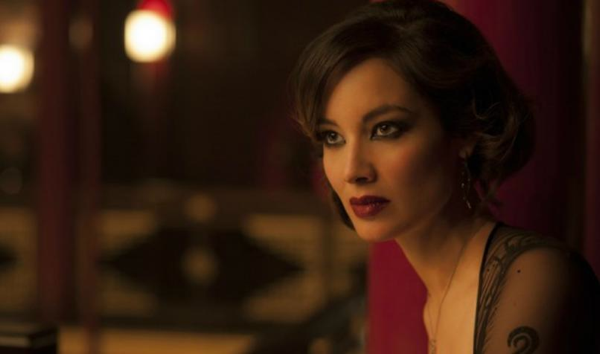
NewImage

Let's start with Eve, who inspired this post. She spends the entire film being punished for a small mistake she makes under M's orders, while Bond goes around screwing up so badly that he can't even pass the physical fitness exam. Even worse, despite saving Bond's (and everyone's) lives twice in the interim, she somehow decides that she's not competent to be a field agent, simply based on a throwaway comment from Bond. The kiss of death? It turns out that she not only decides to be a secretary, she's actually gonna be that secretary (you remember the one. In fifty years of Bond films, she's notable for alternating "sexy" and "nagging" and "why don't you ever return my calls?".

To be honest, if she started the film as a secretary who went out into the field and then decided she wanted to stay behind the desk, I might have hand-waved it. But to invite the audience to smile knowingly as a capable agent surrenders her power to a man who was once her equal palls.

And why the hell did she end up shaving Bond? Is she his wife? Fail.

NewImage

The head of the government inquiry may have been a touch long-winded, but her points were neither hysterical nor invalid. And as any student of the British government knows, long-windedness is not an affectation, but an expectation. Mallory's flippant shutdown of her right to speak (she's the fucking head of the inquiry!) is both against the way government inquiries work, and just flat offensive. And also, the audience is supposed to laugh. Women talking too much! Hilarious!

NewImage

The whole Séverine subplot was incredibly bizarre. Bond finds her both traumatized and full of fear from being sold first into sex slavery and then to Silva, and nonetheless chooses to have her by sneaking up on her in the shower. Of course, James Bond is basically male privilege made flesh, but come on dude, she's TERRIFIED. She doesn't want your dick. Also, if he was so desperately taken with her, one would think he'd have slightly more of a reaction to her death-by-dick-measuring-contest. But la-di-da.

NewImage

M comes closest to success, but we've spent enough time with her to know her pretty well (remember her fantastic introduction in Goldeneye?) Nonetheless, she dies pretty stupidly. She has no facility with a gun, knows it, but still sits out as a target, despite a wonderful escape route? Sure, she set off some exploding chandeliers, but what was the plan here? She's the head of the MI6, not some domestic terrorist. So we not only get Mallory accusing her of incompetence, she proves him right. M, who never makes a false step, makes a series of them in Skyfall. So she dies, freeing Bond of the only female who can stand up to him in every regard.

NewImage

After the women are handily put in their places, Skyfall leaves us with the image of Bond and Mallory talking shop, drinking whisky and smirking about a job terribly done (guys, the head of MI6 is dead! I don't know how you define a job gone horribly wrong, but I am PRETTY SURE THAT'S ONE OF THEM). Mallory failed to track Silva despite Q's technical wizardry, and he still ends up boss. All the women end up dead or demoted, and the men get promoted.

I haven't even discussed the queerification of Silva ("Sure, he's killed a lot of people and blown up buildings, but what's really horrifying is that he might be homosexual!"), but that may be a topic for another day.

So long and thanks in advance for your polite, well-reasoned comments.

Anti-Suffrage Ads of Yore: The Threat of "Petticoat Rule"

2 Comments »

Vote no1

"Housewives! You do not need a ballot to clean out your sink spout!"

NewImage

Published by the Albany Association Opposed to Women's Suffrage. What makes this even more odd is that one of the main contributors to this organization was Mary Arthur, better known to you as the sister of President Chester Arthur.

Olympic-Sized Discrimination from Japan

No Comments »

NewImage

I'm not gonna beat around the bush. Japan's Olympic authorities booked their male football (soccer) team on business class on Japan Airlines, and sent Nadeshiko, the female team, to London on economy.

I could lead you around this story with pretty words and carefully disguised anger, but the facts speak pretty loudly for themselves:

Nadeshiko Japan won the World Cup last year, and are expected to win medals in the Olympic Games.

Nadeshiko's won lucrative advertising deals with top sports brands, which the male team has not.

Nadeshiko won the people's honour award from the Japanese government for giving hope and inspiration to the Japanese populous after widespread destruction caused by last year's natural disasters.

The male team fits none of those criteria: they've never won the World Cup, nor are they expected to come anywhere near the awards podium in London. There are no significant differences in size or height between the male and female players.

The only justification for this segregation is sexism, pure and simple. I've signed a petition created by Sohko Fujimoto and Reina Komiya, addressed to the Japanese Football Association and Japan Airlines. We can't change what's already happened, but we can sure as hell let them know that this is completely unacceptable. The petition takes about ten seconds to fill out.

I want to sign the petition.


Political Animals vs. The Good Wife

No Comments »

NewImage

Two episodes of Political Animals have left me with less of an opinion on the show itself, which is a sort of feel-good trashy romp with a facade of political relevance, but with more appreciation for the narrative construction of The Good Wife.

Superficial comparisons abound. While Political Animals explicitly bases its lead on Hillary Clinton, The Good Wife uses the story of the jilted political wife to deliver a deep dive into how politics, relationships, professionalism tie in with the consistently difficult task of being a woman.

So while the story has to go through some of the same beats (the iconic image of the wife standing by the husband on the podium as he admits his faults, the horror of discovery, the complexity behind the decision to stay or leave), it's telling which beats each story omits.

NewImage

The Good Wife doesn't spend a lot of time on the tears; when we meet Alicia Florrick, she's competent, she's independent, and she's completely certain of what she needs in her professional life. The Good Wife focuses on how she moves forward, not what brought her to this point. We're shown exactly why Alicia doesn't leave Peter as yet, and we realize that in the end, dealing with Peter's the lowest priority in Alicia's life, given that her whole world has come down around her. In fact, it isn't until season three that we get the scene where Alicia first learns about Peter's indiscretions.

Political Animals, on the other hand, seems totally mired in the relationship between Bud and Elaine. One major problem with the show so far is how Bud seems to have such a hold on Elaine's life, even though there's no evident reason why she would ever have loved him, why she would have stayed with him, and why she relies on him now. We're shown, again and again, that she doesn't really need him in her personal life, so allowing him back in doesn't seem true to the character.

I'll allow that few shows get off to such a strong start as The Good Wife. It almost seems churlish to compare the two: TGW is a novelistic tale that teases out very serious themes, while Political Animals aims to be trashy entertainment (and succeeds admirably). Nor should they be more similar; Alicia and Elaine, despite the surface similarities, are very different women. If anything, Elaine's more of an example of when the world crashes down on a Diane Lockhart.

All that said, Political Animals does manage to mimic my personal favorite aspect of TGW: the Alicia/Kalinda. As with that favored pair, PA features a wonderfully prickly but respectful relationship between Elaine and Carla Gugino's fabulous reporter. It seems that in this show, too, the tensions between their deeper solidarity will drive the show forward. And I can't wait to see where it goes.

NewImage

Twitteruption HPV, and A Plea for Sense

4 Comments »

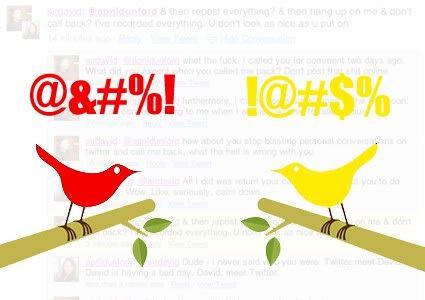
twitterfight.jpg

Another day, another twitter fight. These twitter fights have clear rules:

-The initiator clearly did not think through their initial post.
-The initiator takes offense when someone points out that they may have said something wrong.
-The initiatior heaps abuse on the rebutting commentator, and often draws in troops of followers to magnify the abuse so much that no one remembers what they're fighting about.

If you treat Twitter like your high school gym locker, you deserve everything you get thrown at you, even if I share your political/societal/media beliefs.

I'd tell you more of this particular fight, but unfortunately, I don't even feel right revealing who started the fight, given that the initial tweet violated someone's privacy in a frankly heinous fashion. (You can delete tweets hours after you write them, but an hour is a lifetime in social media. The damage is done.)

I'm not looking to turn this site into a gossip column ("Can you believe she said that?"). I'm commenting on this only because this is the third time this has happened this week. Three times now, there have been two people, who seem to be on the same side, who suddenly get into an argument and invent a fictional gulf that cannot be traversed.

In all three cases, the arguments ended with cat-calling, which is frankly embarrassing for the people involved, all of whom are respected political and/or feminist commentators.

In my more pessimistic moments, I wonder if all these new methods of connection and communciation are actually offering distant people more opportunity to abuse each other.

I also wonder if our increasingly uglier national conversations are seeping into personal conversations, normalizing abuse and unfounded accusation and responses made out of anger.

You see, I've always felt that part of the magic of the written word that you can edit out the insults, you can trim the fat and excess, you can reduce your response to the most naked poison if you choose to, and you can do so without cheap insults or expletives.

You can lay out your argument logically and persuasively, and you don't need to demean yourself in the process.

Would anyone have put down Jonathan Swift's "A Modest Proposal" because it was vulgar or rude? Of course not. They would have read until the end, and then, maybe, realized they should be offended. That's what writing is. It's a sleight of hand.

Even with hot-button communication methods like twitter, there's always a hesitation before you press enter; if not, there should be.

What burns me is something my mother has told me again and again: you can be saying the right thing until you're blue in the face, but you have to say it the right way, or no one will listen to you.

It really burns me (every pun intended!) that we really ought to be having a national conversation about HPV; women in this country need objective information about how you get it and what can happen if it goes untreated. But namecalling and saying that "Well I have HPV and cervical cancer and therefore I should have the loudest voice" doesn't help anyone. It just tunes people out, and it makes them less receptive to the facts.

On Gender Issues, Nostalgia and Fiction

10 Comments »

daenerys-dragon-1920-600x337.jpg

If you've been following the blog-o-sphere, you might be aware of an internet spat over the depictions of women in The Game of Thrones. I've been following it with interest, though I've only seen the HBO series and haven't read the books.

While I don't feel comfortable taking a stand on TGOT, (please do read Sady Doyle's original post and Alyssa Rosenberg's response), I am very interested in the broader issues raised. I recognize that you may not all agree, and I only ask that you please be respectful in the comments.

Alyssa Rosenberg framed the following questions on her Google Plus page, which I aim to answer here:

1. Do you believe that consuming period or periodized literature implies a nostalgia for that time period?
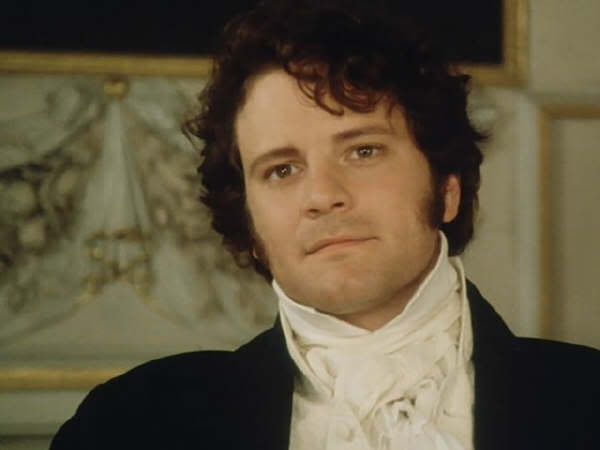
mr-darcy-1.jpg

I do believe that writers who choose these settings can be nostalgic for those settings, i.e., "I long for a time when detective stories didn't require many pages of my hero performing a Google search."

But then again, I believe you can treat certain settings almost as mini-genres. A medieval setting carries certain story-telling expectations, as does a space colony setting, as does an Emerald Isle setting. The same is true for stories set in 19th century Bath, England.

As readers, I believe our consumption of periodicized literature is guided by our preferences for particular mini-genres. But I think for a reader to make the choice to read AGOT or Lord of the Rings instead of, say, Ivanhoe, means that the reader has explicitly chosen works that reflect the contemporary period rather than the historical one.

It's also a very lazy, superficial criticism: "You only like Mad Men because you long for the days when men were men and could sleep around and drink all day."

That said, I think readers can be nostalgic for certain aspects of a period, if not the totality. Regency-era fiction is making a mint off of young girls who wish they lived in a time when social relations with men were more regimented, more polite, and less dependent on scary things like sex. But that doesn't mean they want to live in a time when they can't inherit property or vote.

2. Should fantasy stories take place in ideal worlds or worlds that are designed to provide useful thought experiments?
Time20Machine20196020George20and20W.jpg

I'm inclined to say neither. While there successful examples of both (Star Trek: Next Generation, Atlas Shrugged) you run a powerful risk of boring the crap out of the reader. You can start your story in an ideal world, but it can't stay that way, for then it would lack tension, aka that thing that makes stories interesting.

But what is an ideal world? There is no ideal world that's ideal for everybody. The far future in H.G. Wells' The Time Machine is wonderful for the Eloi, but they're not even aware of what's happening under their feet. In Brave New World it's all happy sexy times for everyone, except for the people for whom the drugs don't work.

As for "useful thought experiments?" That just sounds horrible and didactic. Fiction can and should engage with serious themes, it should be provocative, but those ideas should never be privileged over narrative. To paraphrase Bill Clinton, "It's the imagination, stupid."

3. What is the point at which depictions of domestic or sexual violence become gratuitous? Why do depictions of sexual or domestic violence have to meet a different standard than aestheticized action violence?

irreversible-photo_04_hires2.jpg

The first is a question that even the Supreme Court cannot answer, and I'm not sure we can either. Basically, you are asking at what point does a work stop generating artistic interest and only generate prurient interest?

In lit, if it doesn't drive a character or the story forward, then it's gratuitous. Period. If it's described in unnecessarily loving detail, it's gratuitous. How do you judge whether it meets those conditions? It differs from person to person.

As for the second question, I was not raised in a household where this was true. My parents would infinitely prefer I watched Law and Order: SVU even over the anodyne action violence in The Matrix.

That said, I think this has something to do with the real world. You will never run into aestheticized action violence in the real world, but you are very likely to encounter, be a victim of, or know someone who is a victim of sexual/domestic violence. Because being raped is a real fear, people are more disturbed by it than if their city was blown up, which is not a real fear for most in the Western world in spite of outlier attacks.

4. Is it necessarily sexist to depict female incompetence?
willie-scott-20080522003658647-000.jpg

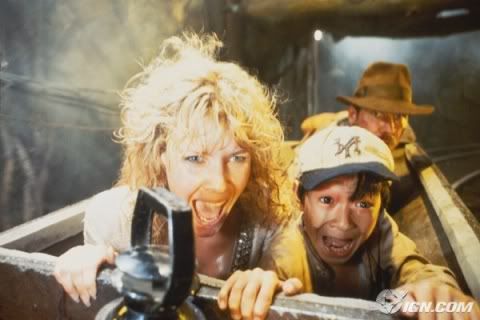
Definitely not. It certainly can be, especially if all the female characters are incompetent, or there's only one female character and she's incompetent (i.e. Willie Scott in the photo above), but it's ridiculous to say that this is necessarily the case. The problem is when otherwise competent women are portrayed as making silly decisions without any background as to why.

Why, as feminists, are we meant to stand up for all women? Am I expected to defend Margaret Thatcher, Sarah Palin or Michelle Bachmann? Absolutely not. Then why must we pretend women like this don't exist in fiction? Lot's of women don't like each other for many reasons, most of them quite valid. To pretend this is not true renders any work toothless. Unless of course it's a "useful thought experiment" demonstrating a world where all women are competent.

Let's look at The Handmaid's Tale, by Margaret Atwood. No one's gonna argue its feminist bona fides, but the most flat-out evil character in the novel is the woman in power, the Commander's wife. Is that somehow sexist? Certainly not. It expresses a truth: there are some women, like there are some men, who would do anything to hold onto their power. Likewise, there are other women who fight against those people in power.

THANK GOD THAT'S OVER

So what do you guys think about these questions? Any examples or counter-examples you'd like to bring to the table?

Weigh in in the comments, folks!

The Most Important Lesson from "Gloria Steinem: In Her Words"

2 Comments »

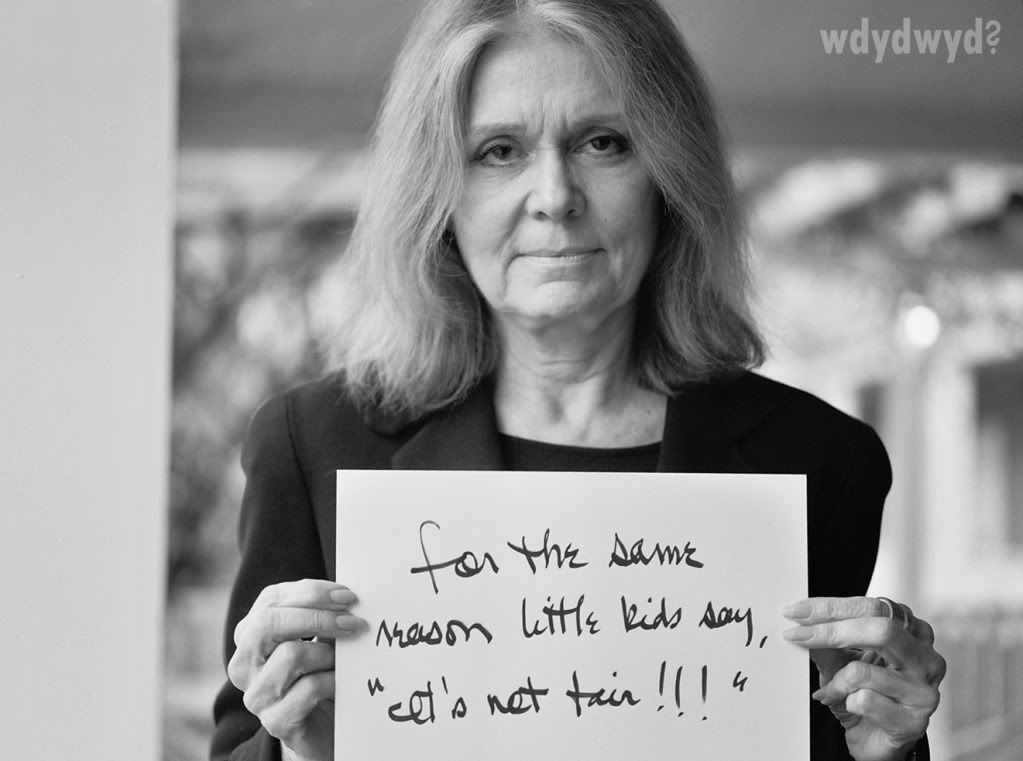
SVN06_GloriaSteinem.jpg

Gloria Steinem has been involved with, guided and even transformed almost every major issue in the feminist movement, but there's something about her particular brand of feminism that seems to transcend any one issue.

I've been trying to think why that is. I really enjoyed HBO's documentary, which didn't feel sensational even though it covered a woman who was frequently, well, sensational.

So what makes Gloria Steinem so appealing? I admit, until I watched this documentary, she was very little more than a name to me, the woman who founded Ms. magazine and went undercover to expose the exploitation of the Playboy Bunnies (and I vaguely recall that, on the Mary Tyler Moore Show, she's presented as the ideal woman by all the men. Can you imagine a mainstream tv show choosing a feminist as an ideal woman today? Maybe Parks and Recreation. But I digress).

I wonder if this is an institutional problem: in all my gender history related courses at university focussed on academic thinkers at the expense of activists, which is sort of the opposite way to how education covers other civil rights and human rights issues.

This is important to note because there are very real, substantive differences between academic feminism and real-world feminism, the chief one being pragmatism. Steinem carries herself as intelligent, not bitter. She wins crowds through humor, not through righteousness and anger. If she loses a fight she doesn't retreat, she thinks immediately of the next step.

Watch this interview about Hillary Clinton losing the Presidential nomination:

She moves quickly from explaining the significance of Clinton's achievement to why the loss is disappointing to the lessons Barack Obama can learn, and by the end, you feel she genuinely supports candidate Obama. That's an amazing ability, to be true to oneself and also find ways to be positive about an alternate future (or at least to come off that way). It's incredible that she can praise and bury Clinton and manage not to insult Obama in the process, not even in a back-handed way. That's grace, that's elegance.

But I'm not suggesting you take away good sportsmanship from the documentary, but something altogether more difficult: compassion. I believe she was able to unite so many people, to affect so many lives, because she didn't frame the feminist movement in terms of power but in terms of empathy and kindness. Again and again, she stresses the ideal end result: a world where both men and women can live lives reflecting their better selves. To achieve that ideal, you can't have discrimination. It's as simple as that.

In an era where Internet debate on gender becomes ever more rancorous, it seems valuable to remember that lesson: be compassionate, remember what you're fighting for, and do not act in such a way that belies that eventual goal.

For those of you who are interested, here's a great interview that Steinem did about the documentary with Maria Shriver: http://www.interviewmagazine.com/culture/gloria-steinem/

Oncoming Hope, out.

P.S.

I can't find a clip, but in the documentary there is a horrendously awkward interview on Larry King Live from 1991 which seems to have inspired all the awkward humor you'd see today on Parks and Recreation or Arrested Development. Essentially, a woman calls in and says she's been waiting 15 years to talk to Gloria Steinem. Bright smiles all around. Then, you watch Larry King's and Steinem's faces fall as the woman proceeds to accuse Steinem of destroying the world and American society. It's horrible, but you almost can't help laughing.

Can You Be Anti-Choice and Also a Feminist?

23 Comments »

3-1.jpg

Any woman who calls herself a feminist believes in certain broad tenets -- particularly that women have the right to equal pay, equal access and equal rights both in marriage and in autonomy.

Lately there's been some controversy over whether you can be a feminist and be anti-abortion, and the general consensus is that no, you cannot. I don't entirely agree. Now bear with me here.

The problem is that, apart from the fundamental tenets I listed above, very little else is actually agreed upon within this big banner of feminism. Some believe pornography is always wrong (Dworkin and Mackinnon) while others believe it leads to healthier, stronger relationships (Tracy Clark-Flory). Some believe that any sexual relations with a man equals rape (Dworkin and Mackinnon again) and some believe that women should be free to have sex the way men do, freely and without consequences (Jezebel feminism).

So why then, is feminism so instantly exclusive of women who don't believe in the right to abortion, or who believe that an abortion actually constitutes the taking of a human life? I'm not talking about Michele Bachmann or Sarah Palin or Ann Coulter or the women who believe in that "men are the head of the household and women should know their place" crap, but women who believe in equal access and equal pay but simply believe that abortion is immoral.

I'm going to state now that I'm adamantly pro-choice, but that doesn't mean I'm not empathetic to that position, whether I agree with it or not. In fact, I believe this position is acceptable within the big feminist tent, but only conditionally:

  • Birth control options must exist that are 100% effective.
  • All women old enough to conceive receive thorough sex education, not abstinence-only education.

As we all well know, these conditions aren't close to being met. Yes, we are pretty close to achieving the first, but we are nowhere near the second. You might even go as far as to strike condition 1 and prioritize condition 2, as it is only fair to expect women to face the consequences of their actions if and only if they are empowered to make informed decisions.

If ALL WOMEN are adequately informed and continue to make lifestyle choices that lead to unintentional pregnancies, then I think it is not inherently anti-feminist for you to have the position that abortion should not be allowed except in cases of rape or incest.

I won't agree with you, but that's fine. I don't agree with Dworkin/Mackinnon, and I don't agree with Jezebel either. People keep trying to make it so, but feminism is not now, nor has it ever been, about ideological purity. It's about achieving broad-stroke equality, and there is room for disagreement about the finer points.

But I maintain that, in a system where so many women are inadequately informed about birth control options and the actual, real-life consequences of sexual activity (not the "your soul will burn in hell!" variety of consequence), then it is anti-women to support an outright ban on abortion.

When 18-year old girls tell you about losing their virginity at some freshman party they went to and then whisper to you "it's ok, you can't get pregnant the first time," then how is it fair to make them beholden to the consequences? They may have made that decision to have sex, but they did NOT know what would happen as a result of their uninformed (misinformed, in this case) state.

You will notice that I have not mentioned a 3rd condition, which I consider the most important of all, practically speaking: Society must have the infrastructure to support women who are economically or otherwise ill-equipped to raise a child. If you are going to require a woman to carry a child on the grounds that not doing so is murder, then you have to provide for the child after birth, otherwise you completely ruin the mother's opportunity to achieve those fundamental feminist goals of equal access, equal pay, etc.

So to sum up, in order for an anti-choice position to be acceptable within the big tent of feminism, the burden is on society to provide both robust prevention strategies and post-birth coping strategies for those women you would disallow from terminating the fetus. In American society today, we are lacking in both. Until we have both, I don't even consider women's right to choice worth arguing within feminism.

The Least Effective Way Possible To Combat Misogyny in Gaming

No Comments »

a-battlefield3.jpg

Well this is dumb. A large gaming club holding a LAN party in Texas, scheduled to celebrate the launch of EA's Battlefield 3, have decided the best way to stop female gamers from being verbally abused is to not allow them in.

“Nothing ruins a good LAN party like uncomfortable guests or lots of tension, both of which can result from mixing immature, misogynistic male-gamers with female counterparts,” the organisers originally wrote in an event FAQ. “Though we’ve done our best to avoid these situations in years past, we’ve certainly had our share of problems. As a result, we no longer allow women to attend this event."

Um, hello? So this group has elected to privilege the "immature, misogynistic" morons over, for instance, policiing that behavior? Needless to say, this kicked up a shitstorm, forcing the organizers to replace the post with something even sillier:

“This event is a ‘gentlemen’s retreat’; as such we do not allow women to attend.”

Gentlemen! I assume they're referring to the same sort of couth male who attends "gentlemen's clubs."

Then, that was replaced again, by:

“We actively discourage gamers from being the kind of mysogynistic jackwagons seen in the Reddit post, and such behaviour should not be tolerated. Frankly, we don’t like that kind of player either. So far as this event goes, it is an special event designed specifically for male gamers. Further, it is meant as a getaway designed to help said male contingent become better men both for themselves and for those who love us.”

Now there are a hundred things wrong with that. One, there original post shows that the organizers do not care to "actively discourage gamers from [...] misogynistic jackwagons." In fact, they are creating a safe space for them to behave that way without consequences. I'm not making that up, it's there in the original FAQ. "We don't like sexist jerks, so we're making this a special event, just for them." Secondly, I don't think I have to go far out on a limb as to say that both "themselves and the ones who love us" will all be present at that party.

The organizers are well within their legal rights to exclude anyone from their private event, but this sort of behavior leads to one unfortunate, likely erroneous, conclusion: the type of people who'd enjoy this game are immature, misogynist jerks, and this game brings out the worst of that behavior. This is probably not true, but these assholes certainly make it seem that way. If I were EA, I would formally distance myself from this group.

Parsing the Media: "The IMF: Violating Women Since 1945"

No Comments »

dominique-strauss-kahn-sex.jpg

For the record, I am ignoring the extremely silly headline for the article, as headlines by their very nature are overstated and manipulative.

As I was reading an article about the IMF's historical complicity with women's rights violations, one sentence struck me like a baseball between the eyes:

For many in the developing world, the IMF and its draconian policies of structural adjustment have systematically “raped” the earth and the poor and violated the human rights of women.

I could go on about grammatical incorrectness and general object-verb failures (and oh, how I want to!) but I'll forgo my grammar nazi reflexes. ("Get to the point, miss oncoming hope, perilously lodged in your glass house!")

It's that word, that word that stands in the middle of the sentence, visually punctuated with quotation marks to guarantee that you don't miss it (there's no other reason for the quotation marks to be there, unless it's a word quoted directly from original speech made by 'many in the developing world', the 'earth' or 'the poor').

Now I read the rest of article because it was recommended by someone I trust, and because I am generally interested in the tyranny of IMF structural adjustment policy. And of course I am interested in international organizations and the systemic oppression of women.

But I couldn't get that "raped" out of my head. No matter how salient the rest of the points in the article might be, that one word has primed me to read the whole thing as overblown and exaggerated. That word tells me this article is written by an activist not an informer. It tells me that every sentence is colored with pre-conceived notions rather than respect for fact.

I accept that hyperbole is the bread and butter of internet commentary. But in most cases, especially as regards to political economy, the facts and the statistics are outrageous enough. The policies that have made the sex trade the only available occupation for thousands of women are deplorable on their own. But poorly formed policies that have been proven not to work do not directly equate to "violations of women's bodies."

I am not a Pakistani Muslim Cunt

1 Comment »

I am not a Pakistani.

I am not a Muslim.

I'd add that I'm not a cunt, but if the first two statements failed to register, why should the third?

You said that your daughter can't get a job because of me. Because of me? Really? I'm sure I am personally the one who stopped your daughter from succeeding at school or at university.

I'm sure that I'm the one who suggested that backpacking abroad is more important than learning a trade.

I'm sure I'm the one who gave her an unjustified amount of self-esteem in the form of "It's OK. I'm wealthy. Your performance is irrelevant."

You said, "Don't worry. I won't touch you. Because you're filthy." I thank you for that. Who knows if I'd have the courage to speak back if you hadn't said that. But all it took was for me to say "I'm not a Muslim," for you to charge down the street after me. You said that you wouldn't touch me. But why should I trust you?

And so the conversation progressed, all too predictably:

"You fucking Paki Muslim cunts have ruined this country!"

"I am not a Pakistani. I'm American." You can surprise yourself at the oddest of occasions. I've never identified myself as American before. Too many contradictions.

"You're a fucking Muslim cunt!"

"I'm not a Muslim either. I'm Hindu."

"No, you're a fucking Paki Muslim Cunt!"

Now there's a logic I cannot argue with.

It was 11:00 in the evening in Islington, on one of the clearest, most beautiful nights London has ever seen. You can complain about the cold, but you can't deny how beautiful the stars are on any icy evening. And all this from a black man.

On the 'Trumped Up' Rape Charges Against Julian Assange

1 Comment »


Fair disclosure: I myself had a suspicion that these charges have been overblown as an excuse to bring Assange into custody. However, I did not feel remotely comfortable with that suspicion, and I'm glad I took the time to find factual justification before contributing to the caravan of dervishes whirling around this case. I definitely would not want to contribute to the 'blame the victim' culture that surrounds allegations of rape and sexual assault.

Now that Julian Assange has been apprehended by the police in London, the blogosphere has exploded with ill-informed opinions about the charges brought against him, ranging from hysterical misogyny to anti-government cynicism to glorification of conspiracy theories. And now for some devil's advocacy to augment this witch's brew.

Having done a little bit of research into the exact nature of the charges and of new information that has come to light, I have concluded that if the allegations are true, then under the letter of the law, Assange absolutely should be brought to trial (on the sex crime charges only). I'm going to leave aside my opinion on the 'correctness' of related laws, and merely discuss them in relevance to the case.

THE CRIME

Despite the reports in the media, the crime that Assange is being charged for is 'sexual coercion and sexual molestation' and not 'sex by surprise.' There is no such thing, I repeat, no such thing as sex by surprise, which is in fact an offensive colloquialism for rape in Sweden.

So what did Assange actually do? All the commentary along the lines of, 'ha ha, now sex without a condom is a crime, gotta get written permission before having sex with a women!,' completely misses the point at best, and at worst exposes a formerly latent misogyny in the left. (Ironically, some of the most virulently anti-women comments appeared as agreement with a Naomi Wolf(!!) article defending Assange).

The legal principle behind the two women's charges is 'withdrawal of consent,' the idea that a woman may consent to sexual relations and then withdraw them at any point. In the first woman's case, she agreed to have sex only if Assange used a condom. In the bedroom he refused the condom at some point and she repeatedly asked him to stop, but he forced himself on her anyway. (In fact, the latest release of the police report states that he used his body weight to hold her down). This is the basis of the sexual assault charge. In the second woman's case, he had sex with her while she was asleep (no consent there!), and did not use a condom on that occasion either, even though she'd also agreed to have sex only with condoms. This is the basis for the molestation charge.

There are two forces at play here. One, it is difficult for many Americans to grasp the very concept of 'withdrawal of consent' as a basis of a sexual assault charge, as it only exists in certain states and is rarely prosecuted. Withdrawal of consent is monstrously difficult to prove in a court of law. Second, making a successful legal case against rape in the United States usually entails proving that the rapist used or threatened the use of force to gain sexual power. Until the recent statement by the Swedish authorities, there was no suggestion of force.

This is my basic understanding of the legal context of the case, and I admit that it is just that - basic. Which leaves one conclusion: the law is responsible for determining the validity of the charges. Therefore Assange must be brought to court. I am fairly sure that 90% of commentators would agree if he weren't such an information hero at the moment.

THE PUNISHMENT

While it is likely true that Assange would not have been brought in for this crime if he wasn't so badly wanted for other reasons, the fact remains that under the Swedish law, he definitely committed a crime. Assange's lawyers have repeatedly parroted, incorrectly, that the maximum penalty for this crime is the kroner equivalent of $700, as if trying to diminish the crime by saying it's barely punished. This is false. According to the Swedish penal code, the maximum punishment is 2 years in prison.

The facts are these: the charges may be proven true or false in a court of law (that is why a court of law exists). However, it helps no one to misrepresent the nature or seriousness of the charges themselves, irrespective of the political context. Habeus corpus obliges the law to fully investigate and judge the case on its merits. If the charges are proven false, then the law is equally responsible to investigate and punish the perjurers.

Powered by Blogger.