Showing posts with label Race. Show all posts

Spike Lee's Do the Right Thing

No Comments »

NewImage

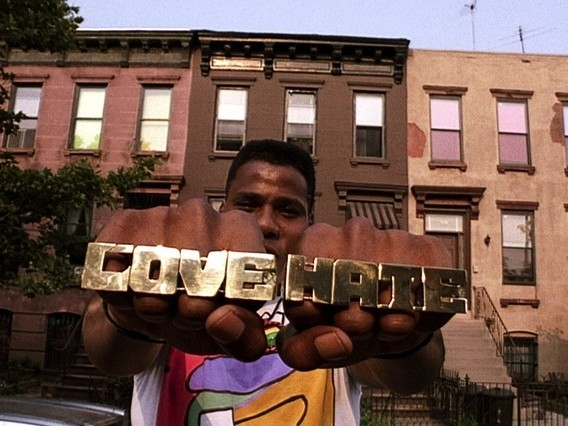
Canadian indie band Stars once sang that when there's nothing left to burn, you have to set yourself on fire. I can think of no better way to convey the shocking final 15 minutes of Spike Lee's Do the Right Thing.

When you watch the film, you'll marvel at how fresh it feels. Following a credits sequence that hits you in the face with "angry-dancing", we're introduced to the social world of a Bed-Stuy neighborhood. Then, as now, the outstanding existential threat is gentrification.

NewImage

Spike Lee chooses to face character complications head-on, and no one's free of scrutiny. Giancarlo Esposito's "Buggin' Out" , the film's would-be Malcolm X, swings easily from overblown concern at the lack of black faces on the wall of Sal's Pizzeria to inviting universal ridicule when a cyclist scuffs his Air Jordans. Lee's camera treats his affectations unkindly, the upward zoom adding extra heft to his already comical hairstyle. Even so, much like Falstaff, this thoughtless dilettante sets the film's tragedies in motion.

NewImage

Sal, our pizzeria owner, professes love for the people of Bed-Stuy, citing his pride that the young adults in the neighborhood grew up on his pizza. Nonetheless, he does not hesitate to call them "animals" and "niggers" when the mood takes him. And yet, there's little doubt that he loves the people he serves, even as a deep-seated disrespect for them wins out over his seemingly better nature.

NewImage

Disrespect really is the order of the day here: whether you're Mookie, Tina, Radio Raheem, Sal, or even Sal's useless sons, how you deal with disrespect defines your character (at least up to a point). Mookie does nothing for so long that his big act almost feels like a triumph. Raheem hides behind his music, and when that's disrespected, he explodes. Sal's deep-seated racism comes to the fore. He's not an anti-social racist like his son, but guilty of ugly prejudice none the less.

The exception is the Greek chorus. They constantly comment but never act. They are less characters than narrators, involved less with the specific lives of the neighborhood than in defining the shapes of the setting. Lee treats them to some of the most beautiful videography in film history as they lounge under umbrellas against a wall painted the brightest red ever seen outside a Tarantino film.

I don't want to linger on the ending; if you haven't seen the movie, you need to experience it for yourself. I will say this, however: la plus ça change, la plus la même chose.

NewImage

Thoughts on the Trayvon Martin Trial

No Comments »

NewImage

I've struggled to record my exact feelings on yesterday's acquittal. The court delivered an awful verdict that suggested that certain key questions are beside the point: What is the crime? Who committed it? Why? How?

Apart from the racial aspects of the case, which others have covered far more eloquently than I could, I'm disturbed by the way the final decision failed to reflect an actual crime. Isn't the whole notion of Western justice based on cause and effect? Crime and punishment?

We're left with the fact that a man was murdered, but hey, that's cool, just an annoying gnat of a fact irrelevant to the case at hand.

No one seems bothered by the proportionality of Zimmerman's act. That a man with a gun shot a kid without a weapon of any kind. That a guy who wilfully ignored police orders should not be allowed a gun in any circumstance.  That even when you strip away all the politics around this, the facts remain: a man with a gun shot an unarmed teenager.

A man with a gun shot an unarmed teenager, and apparently that's ok. What is our justice system even worth when that kind of core simplicity can be flim-flammed away?

This verdict is a travesty, and even if Zimmerman's acts are perfectly lawful, then we have to question the substance of the laws themselves.

Let's see how the civil trial fares.

Videogame Company Fights the Diversity Fight

No Comments »

NewImage

Life-affirming pleasures often come from the strangest places: in this case, Gaslamp Games' blog on a new project based on the Victorian era:

We feel it’s important to have people of all colours in the game, basically. I’m not going to get into the exceedingly grim history of 19th century colonialism here, but I assure you we’ve had a lot of internal discussions about how we can possibly approach making a game vaguely based on the Victorian era without being ridiculously offensive.

I've written elsewhere about how writers seem to choose to set their work in certain eras because they want to pretend there was a world before integration, where white men could be white men and society celebrated even their worst excesses. But as David Baumgart points out, that world NEVER EXISTED. It's heartening to hear Gaslamp engage with the issue, even though I have no doubt that the outcomes won't be perfect.

I've only recently began to engage with the politics of the video game world. To tell the truth, until I played Half Life 2, I had no idea there was a place for lead characters who aren't white male jocks. I recall years of playing Goldeneye as Natalya, the only character in any video game who felt in any way relevant to me (and she's still white, so really not that relevant), given that she looked like an actual scientist and not, let's say, Lara Croft (or Mileena/Kitana, or Chun Li, etc).

Happily, this ignorance allowed me to enjoy years of games like Zelda 64, which are almost completely intolerable when looked at through any kind of feminist lens (look at all the women who exist only to coo at Link or be rescued from their fates!).

But I'm glad to see a new world where developers are actually thinking through how world-building impacts audiences who play their games. Would you really want to spend 40-60 hours in a world where no one looks like you? Why would you spend that kind of time in a world that explicitly gives zero thought to you? In this day and age, those are safe spaces for the writers to exercise their own privilege, where they don't have to engage with messy issues like gender and race.

Gap's Totally Not-Racist "Manifest Destiny" T-Shirt

No Comments »

NewImage

About a month ago, Gap released a special series of GQxGap crossover designs by Mark Mcnairy, who GQ dubbed one of America's "Best New Designers." While it's concerning that a man who writes white letters on t-shirts can be consider a "best new" anything, we're not here to talk about design. We're here to talk about manifest destiny.

The charitable view suggests that Mr. McNairy does not know what the term means. Let's let the originator, one John L. O'Sullivan in 1845, explain his phrase:

And that claim is by the right of our manifest destiny to overspread and to possess the whole of the continent which Providence has given us for the development of the great experiment of liberty and federated self-government entrusted to us.

So what did this mean? The Belle Jar explains what this means better than I could (I would just sing a tune of GENOCIDE! GENOCIDE!):

Manifest Destiny and the philosophy behind it are responsible for a whole bunch of really terrible things. It was used to justify the Mexican-American War, the War of 1812, and, most appallingly, the Indian Removal Act. Manifest Destiny was used to vindicate the myriad abuses suffered by people of colour at the hands of white North Americans. It’s the philosophy that lead to our continent-wide reservation system , not to mention the residential schools created for the Aboriginal peoples of Canada.

The effects of Manifest Destiny can still be felt, in the poverty and degradation suffered by American and Canadian people of colour, and in the deplorable conditions found on many reserves, both here and south of the border. The ideas behind manifest destiny still exist in our white western consciousness, as much as we might be loathe to admit it; they come up every time our (largely white) government asserts that it knows best when it comes to First Nations issues, or every time someone complains about how much freaking money has already been spent on Attawapiskat only to have their community still be in a state of crisis. Manifest Destiny is apparent every time someone chooses to be bigoted and wilfully ignorant about non-white immigrants, or tries to deny the far-reaching effects of racism; it’s apparent in the mindset of all the people who never take a moment to wonder why or how so many white people ended up owning so much fucking land.

Unfortunately, social media proves that he's very much aware of the phrase's significance. After one student created a Change.org petition against the shirt, Mcnairy replied with a tastefully crafted tweet (now deleted, of course):

NewImage

Yes, survival of the melanin-deficient folks with the big sticks that go boom.

Gap (and McNairy) probably aren't trying to start a race war; they probably think that "ooh! this is a phrase that someone cool once said, maybe even the sort of hipster who wears black t-shirts with white lettering!" Or even more charitably, "let's reclaim the phrase for capitalism! We're promoting the destiny of lawbooks!"

But Gap is one of the guiltiest parties in subverting human rights by using sweatshops overseas. Even in markets with rigid anti-sweatshop laws, like South India, the conditions are appalling - open sewage streaming out into unpaved streets in remote factories, 12 hour days even when the monsoon floods the workroom floor.

This is manifest destiny today. That it's ok for the "not-we" to suffer so Americans can have cheap clothes.

The lingering effects of manifest destiny, well, they linger.

Mark McNairy has issued an official apology. Gap has removed the shirts from the website, but they're still available in stores. Make of that what you will.

Morning Must-Watch: George Clooney Speaks Truth About Hollywood

1 Comment »

rMqGn.jpg

The Newsweek Oscar roundtable proves, yet again, that Clooney really is the most awesome person in Hollywood. Or Viola Davis is. I'm not really sure. After this short video, I'm in love with both of them, and hope they run off and start a production company that fixes all the lowest-common-denominator ills of the movie business.

The interviewer asks a simple question: why is this Viola Davis' first major role? Maybe he wasn't expecting the answer, but I'll tell you one thing: Charlize Theron definitely wasn't expecting that answer (though it pains me to say it...Charlize, I love you, but shut up now.)

Viola responds politely, and then Clooney starts rattling the sabre. He doesn't say anything we don't all know, but it's nice to know that one of the most influential stars in the world is not only aware, but has a strong opinion (though unlike Viola Davis, for instance, George Clooney has the luxury of directing and producing his own ideal films.)

George Clooney has certainly earned his stripes, but it's difficult to imagine a black female actor ever having that much clout in today's industry. Viola Davis puts it best: "I'm a 46-year-old black woman who doesn't look like Halle Berry, and Hally Berry's having a hard time."

Is Florence + The Machine's "No Light, No Light" Video Racist?

8 Comments »

JtxK0.jpg

Well, let's see: Asian man in blackface performing voodoo stereotypes, chasing after the virginal white woman who beats the native threat with the salvation of Jesus. That's not racist at all! Take a look:

There is literally nothing about this video that isn't steeped in the most dangerous colonial stereotypes. Florence is explicitly styled as a Pre-Raphaelite Mary Magdalene, and we witness her literal fall. Her safe relationship with God is threatened by the evil natives and their evil religion.

It's everything that's terrible about European colonialism over the centuries, all wrapped up in a very ugly bow. It's not even a specific native that's threatening her, it's a composite native. An Asian in blackface!

Let's forget the fact that blackface is never ok, unless you're making a specific point about the wrongness of blackface (see Mad Men, Tropic Thunder) or you're playing the role respectfully.

Let's ignore the fact that this video engages with specific racial stigmas that have been used to downplay the autonomy of natives in Latin America, Africa and Asia.

Let's even ignore the rabid anti-feminism at the very core of the plotline.

What's MOST offensive is the fact that this concept went past the artist, her musicians, the director, the sound crew, the film crew, the lighting tech, the CGI people, and the record company executives and NO ONE PUT A STOP TO IT.

Flail away in the comments.

Too Crazy To Be True: Unapologetic Racism on the BBC

2 Comments »

JeremyClarkson.jpg

Well isn't racism fun! Especially from a taxpayer funded television network! These weren't mildly offensive, like Stephen Fry's statement about women. Frankly it makes the whole Jonathan Ross and Russell Brand thing look like well-mannered jousting.

But I'll let you judge for yourself. If you don't feel like watching the video (or can't at work), it's all transcribed below. Such a stellar display of wit and wordplay has seldom been seen.

The worst part? IT WAS SCRIPTED IN ADVANCE!! So you have to imagine - somebody wrote it and thought it was fine, an editor read it and thought it was fine, the BBC suits signed off on it, and then these idiots read it aloud. At least we can take solace in the fact that Clarkson might actually be fired for starting an actual diplomatic incident by being a complete c**t.

May: Have you ever wanted a Mexican sports car?
Clarkson: Yes, I have!
May: It’s good news, because there is one, and here it is [points to display] and it’s called the Tortilla.
Clarkson: It is not – it is not called the Tortilla! What is it?
May: I can’t remember, it’s something a bit …
Clarkson: So you just made up the name, then, there you go.
May: I’d forgotten, sorry
Hammond: Why would you want a Mexican car? ‘Cause cars reflect national characteristics. So German cars are sort of very well-built and efficient, and Italian cars, a bit flamboyant and quick. Mexican cars just gonna be lazy, feckless, flatulent, overweight, leaning against a fence asleep looking at a cactus with a blanket with a hole in the middle on as a coat.
May: It is interesting because, they can’t do food, the Mexicans, can they? ‘Cause it’s all like sick with cheese on it.
Hammond: Refried sick!
May: Yeah, refried sick.
Clarkson: How much is this Mexican sports car?
May: The refried Mexican sports car is 33 thousand pounds.
Clarkson: That isn’t enough. It isn’t enough because somebody’s paid for that to be developed and it’s gotta be shipped. That’s 800 quid to the car right there.
May: You say that, though, but they do say in their blurb it’s got rack-and-pinion steering.
Hammond: Wow, it’s got steering!
Hammond: I’m sorry, but just imagine waking up and remembering you’re Mexican.
Clarkson: It’d be brilliant! It’d be brilliant ’cause you could just go straight back to sleep again.
Hammond: ‘That’s all I’m gonna do all day.’
Clarkson: That’s why we’re not gonna get any complaints about this – ’cause the Mexican embassy, the ambassador’s gonna be sitting there with a remote control like this. [Clarkson slumps in his seat and starts "snoring."] They won’t complain. It’s fine!

I am not a Pakistani Muslim Cunt

1 Comment »

I am not a Pakistani.

I am not a Muslim.

I'd add that I'm not a cunt, but if the first two statements failed to register, why should the third?

You said that your daughter can't get a job because of me. Because of me? Really? I'm sure I am personally the one who stopped your daughter from succeeding at school or at university.

I'm sure that I'm the one who suggested that backpacking abroad is more important than learning a trade.

I'm sure I'm the one who gave her an unjustified amount of self-esteem in the form of "It's OK. I'm wealthy. Your performance is irrelevant."

You said, "Don't worry. I won't touch you. Because you're filthy." I thank you for that. Who knows if I'd have the courage to speak back if you hadn't said that. But all it took was for me to say "I'm not a Muslim," for you to charge down the street after me. You said that you wouldn't touch me. But why should I trust you?

And so the conversation progressed, all too predictably:

"You fucking Paki Muslim cunts have ruined this country!"

"I am not a Pakistani. I'm American." You can surprise yourself at the oddest of occasions. I've never identified myself as American before. Too many contradictions.

"You're a fucking Muslim cunt!"

"I'm not a Muslim either. I'm Hindu."

"No, you're a fucking Paki Muslim Cunt!"

Now there's a logic I cannot argue with.

It was 11:00 in the evening in Islington, on one of the clearest, most beautiful nights London has ever seen. You can complain about the cold, but you can't deny how beautiful the stars are on any icy evening. And all this from a black man.

Kathryn Stockett: The Help

2 Comments »

The Help is a book I enjoyed despite a million reasons not to. The writing is clunky, the story frequently crosses the line into melodrama, there are many side plots that don't quite resolve, and it commits the ultimate sin - a blonde white woman writes in the voice of multiple African-American maidservants. The author's note goes some way in resolving these issues (obviously Stockett was aware that these elements might be dealbreakers). She makes clear that the white protagonist is a stand-in for herself, and the black protagonists stand in for the imagined lives of her beloved family maid. Like Skeeter, Stockett lost her maid very suddenly and realized, to her sadness, that she knew nothing about the woman who was the most important caregiver in her life due to the inattention of her blood family.

The explanation Stockett provides helped me to forgive the use (overuse!) of written dialect during the Minny and Aibileen chapters, which is jarring at best. But that's been covered extensively by other reviewers, so I won't dwell, except to say that by the end of the novel, this choice isn't as offensive as I thought it might be. Previously voiceless African-American characters are given rich, three dimensional attention. We come to love them, and the very threat of anything bad happening to them burns our hearts. But apart from Skeeter, the Stockett stand-in character, the white women in the novel are written with no such attention. The story of white trash Celia had so much potential but was ultimately wasted.

The book is tagged as 'the other side of Gone With the Wind,' but I thought it more accurately represented 'the other side of the Betty Draper household.' This period in the 1960s was as much a transforming era for white women as for black: the identities of many black women were sublimated by the needs of their white mistresses, whose identities were in turn defined only by their husbands' needs and ambitions. I'd say the biggest problem in the book lies in the lack of definition of that second disempowerment; there is absolutely nothing in the book to humanize the 'evil white mistresses,' nothing to explain or even contextualize their brutality. As a consequence, we end up with rubbish like "Oh, we love her like family, but can you imagine if she turned up at the DAR meeting?" The Help is not a social comedy, and such flippancy is not welcome.

If you took the book at face value, you would believe that the reason these 'evil white women' maintain these attitudes is snobbery and a particularly perverse version of 'keeping up with the joneses', downplaying the more insidious societal frameworks that actually entrenched these power structures. Again and again, the men in the novel (including the senators and governors who are actually responsible for segregationist policies) are shown to be more compassionate and to have a more thoughtful perspective on the issue, even if political reality prevents them from acting. The women, on the other hand, just follow what their friends do, and then brag about it. It's impossible to believe that an entire social structure could have been maintained on so flimsy a foundation.

This leads to a secondary problem, where plot threads dealing with the 'evil white mistresses' are not resolved in any satisfactory manner. Nowhere is the problem more evident than with the 'villain' of the piece, an ex-sorority shrew named Hilly. You can almost see her twirling her mustache in the last 3rd of the novel. Before that, she is certainly a horrible woman, but you can see that many of her negative aspects come from a limitless quest for power, coupled with a heinous lack of self-awareness. Then, all of a sudden, she becomes Dr. Evil, which makes absolutely no sense for a character who's entire reason for being is standing up as the voice of moral righteousness in the community. So Stockett's choice for Hilly to take this turn on the road to an evil mountain lair does not serve as a revelation of deep seated hatred so much as it becomes a magical plot cop-out.

But even that story does not peter out as badly as Celia Foote's. Celia is introduced as a white trash interloper who married the uptown boy that Hilly once had her eye on. Stockett repeatedly alludes to the horrors of Celia's home life that she would do anything to avoid, but never fills in any blanks beyond that. We learn at various points that she's a drunk, that she's unable to carry a baby to term, that she really could be the town slattern if she so aspired. That she looks like Marilyn Monroe. That she is the laziest human being alive. But all of these points are mere attributes, they do not amount to character. In every one of her scenes, I was waiting for some sort of point to the story that failed to materialize. If the only point is that indentured servitude is not the sorriest fate in the South, well that's pretty weak, and grossly undermines the stories of the black women.

But I suspect that the real problem is that there are too many characters and too many stories and too many points to make and so they all suffer in the end. So many characters are introduced, and then take up so many pages of the novel, and yet they don't change in the slightest. We see no development, no change in their attitude one way or the other, which should happen given how many words are devoted to them.

But, as I mentioned, the novel was not really intended to tell their stories, but to bring out the stories of the voiceless servants who have always been treated as background rather than foreground. But let's be honest, the book is short, and there is ample room to give enough detail for characters to be more than caricatures.

I think the most important thing to keep in mind for any new readers of the book is that in the end, it's a light book that's not really intended to take readers out of their comfort zone, but to remind them of the basic human compassion that can shine through even in the most humiliating of circumstances. It definitely succeeds in that, even though it doesn't have the socio-anthropological intrigue that it could have had.

Powered by Blogger.